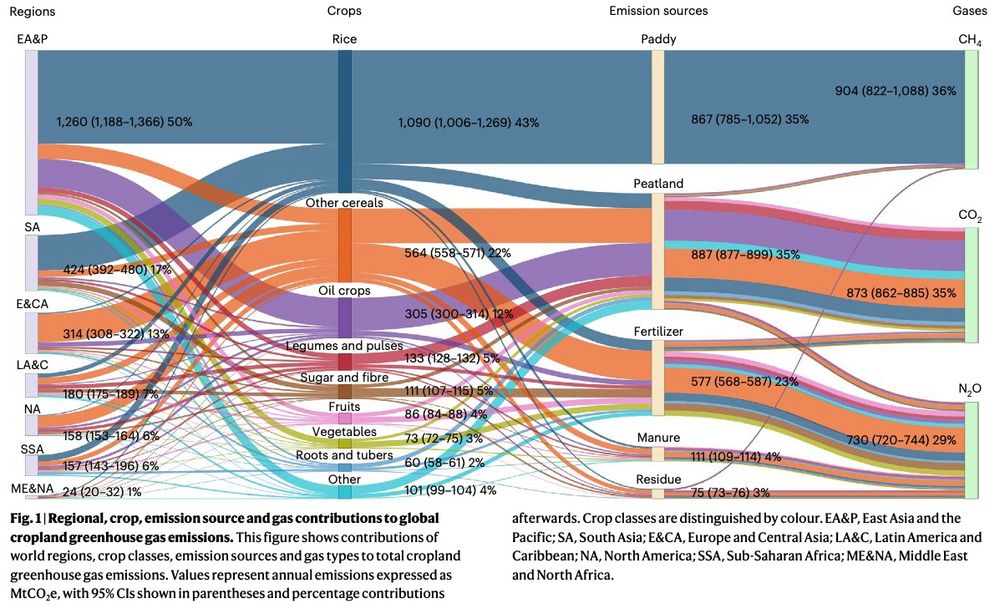
A recent study shows that croplands emitted about 2.5 GtCO₂e in 2020, which is roughly 4% of total global emissions and around 19% of emissions from the land-use sector.
Just three sources explain most of it:
- Drained peatlands (35%)
- Rice cultivation (35%)
- Synthetic fertilizers (23%)
Four crops - rice, maize, oil palm and wheat - account for 67% of total emissions.
The pattern is clear: the most productive regions are also the highest emitters.
So, how can we reduce emissions without affecting food production?
The study highlights several actions:
- More efficient fertilizer use (right source, rate, time and place)
- Changing water management in rice (less continuous flooding)
- Better crop residue management (reducing burning)
- Rewetting drained peatlands
- Practices such as cover crops, conservation tillage and biochar
These solutions already exist. However, they are not only technical. They also depend on economic conditions, policies and farmer decisions.
Source: Cao et al. (2026), Nature Climate Change doi.org/10.1038/s415...