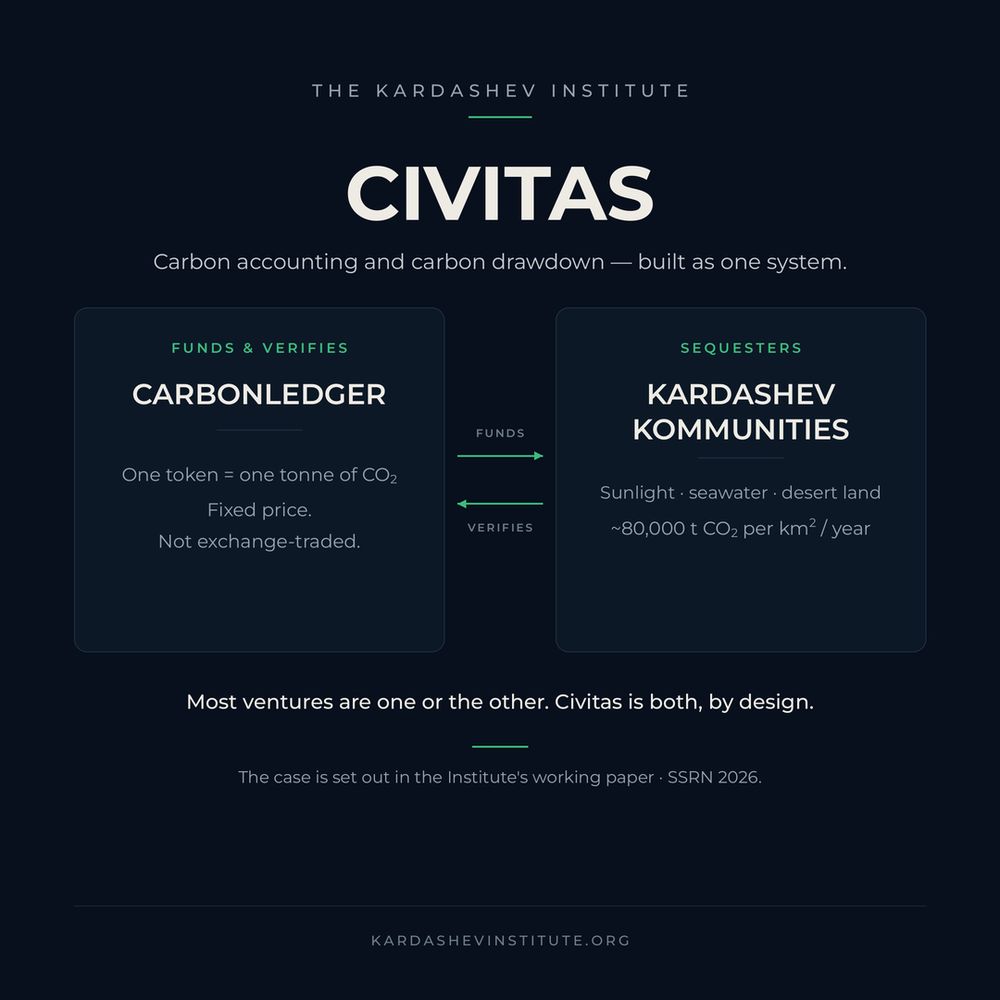
One square kilometre of regenerative desert coast — built from nothing but sunlight, seawater and sand — can draw down roughly 80,000 tonnes of CO₂ a year. The question was never whether it is possible. It is whether anyone funds and verifies it honestly.
The voluntary carbon market is not failing because companies stopped caring about the climate. It is failing because the instrument was built wrong.
The logic of the offset — buy a credit, claim a tonne — has collapsed under scrutiny. Microsoft has pulled back from large offset purchases; airlines including KLM and Delta have faced legal challenge over offset-based green claims. What firms are walking away from is not climate accountability. It is a mechanism they can no longer defend.
The Kardashev Institute's position is that this is a structural problem, not a moral one. A credit whose price floats, and which is matched to a project chosen after the fact, cannot carry the weight of a serious claim.
Civitas, the Institute's response, is built as the alternative — and as a single system, not two products.
CarbonLedger is the accounting and funding layer: a non-speculative protocol that issues one token for one tonne of CO₂ actually emitted, at a fixed price, never listed on an exchange.
Kardashev Kommunities is the physical layer: regenerative coastal-desert settlements made from sunlight, seawater and desert land — each square kilometre modelled to draw down around 80,000 tonnes of CO₂ a year.
One funds and verifies. The other sequesters. Most ventures are one or the other. Civitas is both, by design.
The full argument is set out in our working paper, Carbon Market Failure and the Case for a Non-Speculative Offset Protocol (SSRN, 2026; papers.ssrn.com/sol3/papers....).
We will be at Reset Connect London on 23–24 June, ExCeL, during London Climate Action Week. If you build, fund or govern the transition — and you have watched the offset market lose its credibility — come and find us, or message us here.
[email protected]