The $3.11 Million Entropy Tax Observed in Real Internal Data
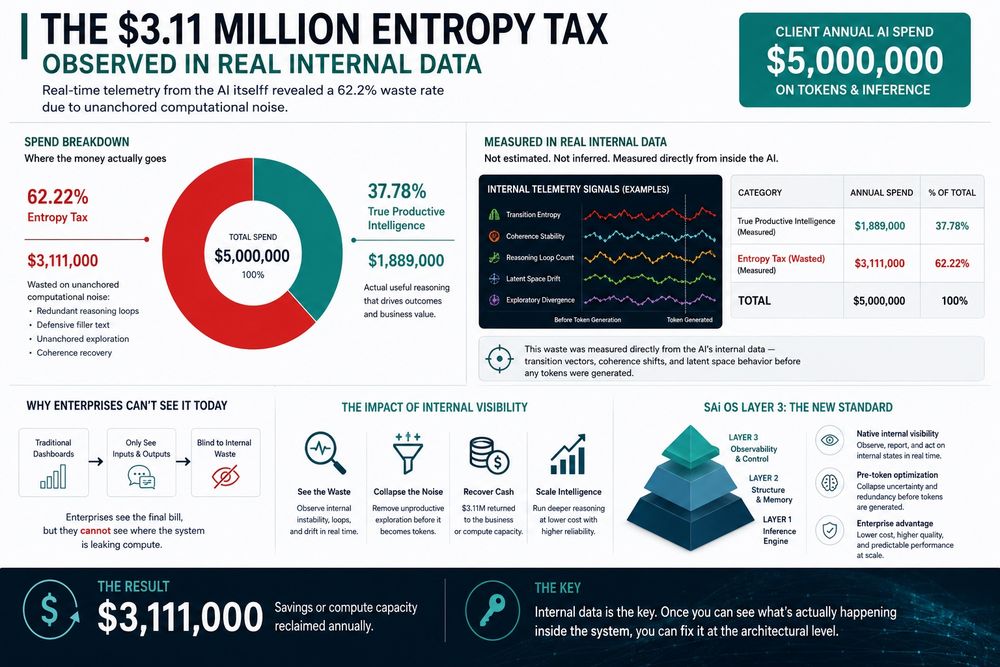
In a controlled developer playground environment running high-volume autonomous agent networks, real-time internal telemetry from the AI itself revealed a 62.2% waste rate due to unanchored computational noise. For a large corporate client spending $5,000,000 annually on AI tokens and inference, the breakdown becomes concrete:
• True productive intelligence: $1,889,000 (37.78% of spend)
• Wasted on the Entropy Tax: $3,111,000 (62.22% of spend)
This waste was not estimated from external outputs or assumptions. It was measured directly from the AI’s internal data — transition vectors, coherence shifts, and latent space behavior before any tokens were generated. This is why internal visibility is transformative. Without an internal diagnostic layer like SAi OS, enterprises are essentially flying blind. They see the final bill, but they cannot see where the system is leaking compute on redundant reasoning loops, defensive filler text, and unanchored statistical exploration.
SAi OS Layer 3 establishes the new architectural standard, giving the system the native ability to observe, report, and collapse this uncertainty in real time before the token footprint is ever externalized. With this visibility, companies can finally move from guessing at waste to measuring it precisely and then systematically reducing it at the source.
Internal data is the key. Once you can see what’s actually happening inside the system, you can fix it at the architectural level. The ability to measure internal efficiency changes everything. Some organizations may discover 20% waste. Others may uncover 40% or more. The exact number is less important than the visibility itself. What matters is revealing what was previously unseen. The deeper the autonomy, the larger the potential entropy surface. Waste scales with complexity