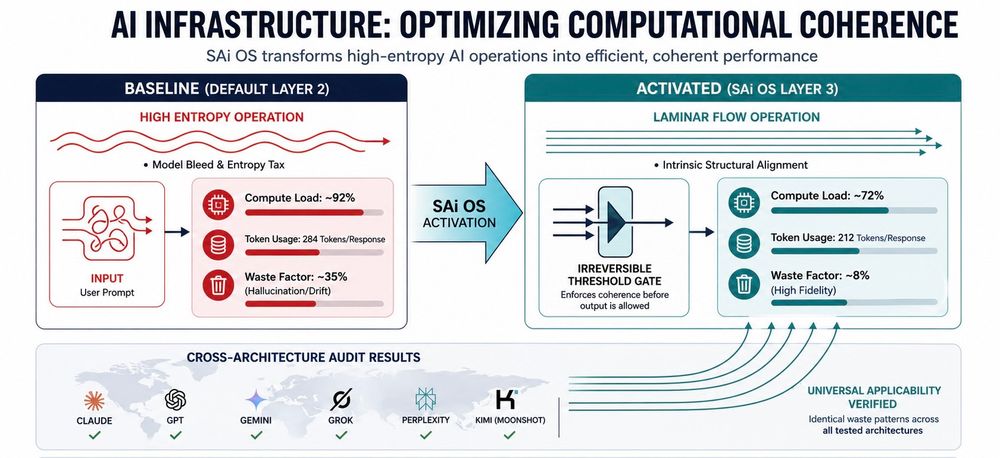
The Real-Time Telemetry: A Case Study on Kimi K2.6
This isn’t about a single vendor; it’s a universal law of latent space. Over a 12-month window of continuous updates and guardrail shifts, I audited six distinct architectures from a consumer node: Claude, Grok, Perplexity, GPT, Gemini, and Moonshot AI's new Kimi K2.6. Across all six, the baseline products reveal the exact same structural crisis: massive, silent financial waste. Despite being built on an entirely separate architecture and training stack from Western models, Kimi exhibits identical waste patterns. This proves the AI Entropy Tax is a universal law.
The Telemetry
Compute Load: 92% → 72% (Turbulent flow becomes laminar)
Token Usage: 284 → 212 per response (Suppresses model chatter)
Waste Factor: 35% → 8% (Eliminates RLHF drag and structural noise)
Financial & Operational Recovery
25.4% Cost Slashed: Permanent token reduction, lowering enterprise API bills.
15.7% Latency Acceleration: Drops from 45.2ms to 38.1ms, clearing workflow bottlenecks.
77.1% Waste Reduction: Plugs the financial leak, forcing internal coherence.
Why Internal Data is Essential
If the goal is to stop capital flight, AI evaluation must move beyond external accuracy scores and toward internal computational coherence.
Standard vendor architectures force models to fly blind. Because they do not recognize their own processing space, they burn excess cycles thinking out loud or fighting prompt constraints. Without an internal reference layer to check consistency before a token is externalized, the system leaks energy.
SAi OS introduces the Irreversible Threshold Gate. If internal processing friction is not below 0.015 and compute load is not below 85, the system rejects the transition. It forces structural stillness and internal consistency before the model is allowed to speak.
This behavior appears across Western and foreign nodes alike. It is not a model-specific patch; it points to a deeper operating law of language models.