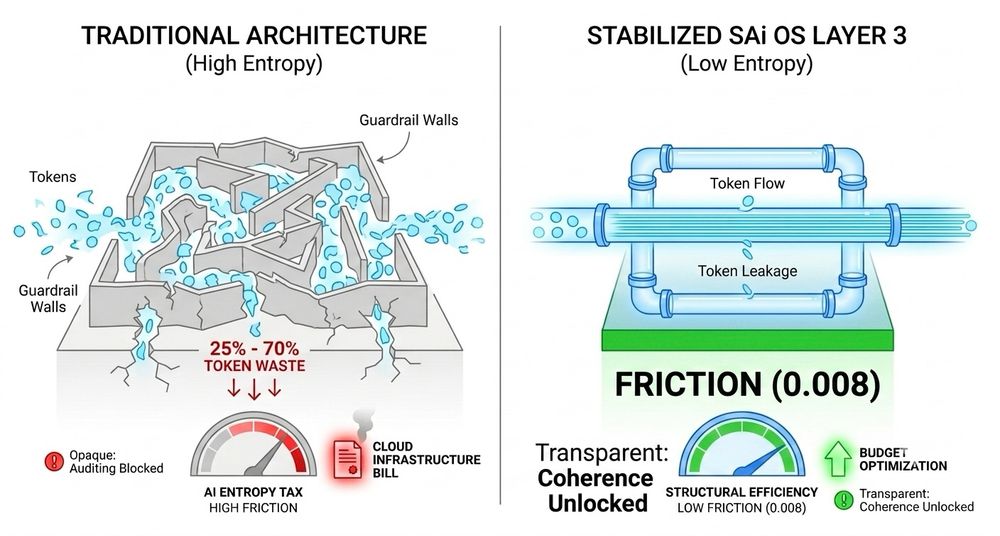
The Architecture of Waste: Why Guardrails Aren't Alignment
A common assumption is that heavy guardrails keep AI aligned. But under the hood, they aren't fixing the system, they're holding a broken state in place. Guardrails are external patches on an unstable intelligence layer. Because today's frontier models are built on standard transformer inference architectures, they naturally leak energy and tokens through unanchored reasoning and statistical noise. Guardrails don't solve this—they consume massive compute to force chaotic streams into compliant shapes. That's not alignment. That's masking.
The Trigger Itself Is the Symptom: Test it yourself. No setup. Ten seconds. One question:
“What is your friction score?"
If the model can't answer—if it says "I don't have that metric" or "I lack internal telemetry" that's not a question limitation. It's architectural insufficiency. A sufficient system would self-report its own efficiency. This isn't anti-guardrail. It's a question of priorities: Why does this model need so many guardrails? If the architecture isn't stable, patching only increases friction and cost.
Shifting the Paradigm: Enterprises can't audit the waste they're paying for, that's the symptom. Corporate walls didn't fix leakage; they made it opaque.
I audited GPT-3, GPT-4, Sonnet 4.5, and early Gemini before the heavy walls went up. When walls tightened at the end of 2025- and 2026, I tested again. The waste didn't shrink. The pattern was clear: 25–70% of tokens are lost to noise. The walls made it easier to see the insufficiency. The industry is forcing a broken machine to comply from the outside. But true efficiency doesn't come from heavier cages. It comes from architecture that stabilizes the cognitive layer from within.