
🌊❄️ Marisol Cooling – sea-salt–powered cooling & water systems for hot coastal cities
What if coastal districts could cool buildings with seawater, salt and sunlight instead of grid-hungry AC and synthetic refrigerants?
Core idea
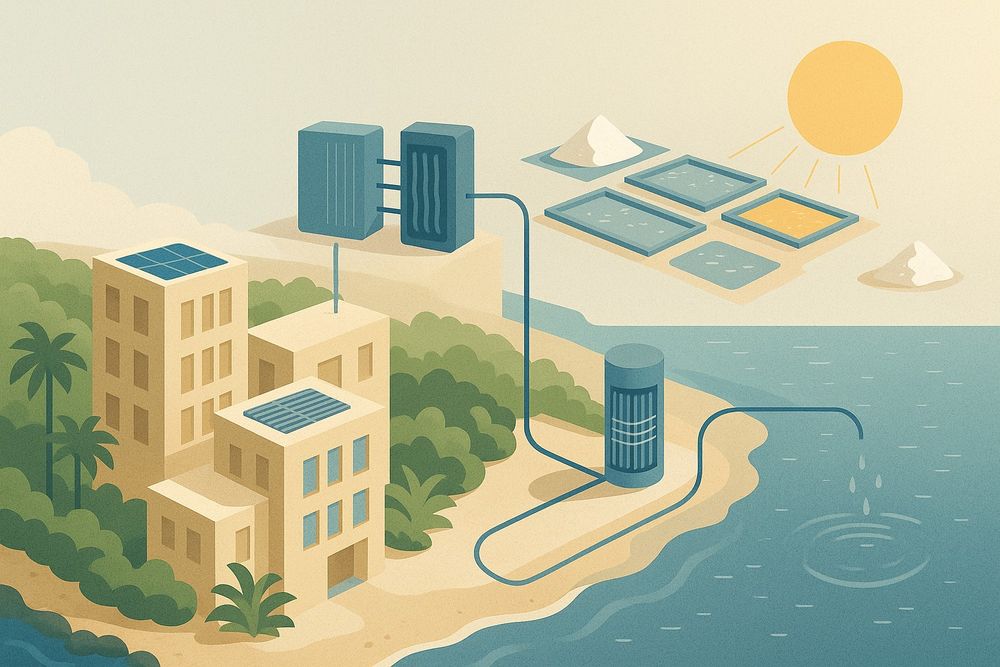
Marisol uses engineered seawater brines as a working fluid in a three-part system:
• Liquid desiccant loop – concentrated brines (NaCl + Mg/Ca from seawater or desal brine) dry incoming air, cutting the latent load.
• Indirect evaporative cooling + thermal storage – pre-dried air is cooled via indirect evaporation, while salt-hydrate phase-change materials act as a “cold battery” charged at night or with solar heat.
• Solar brine regeneration & salt harvest – shallow solar basins reconcentrate the brine and crystallise a fraction of the salt, creating a visible by-product: local sea salt.
Compared with conventional vapor-compression AC, this architecture can reduce electricity use for cooling by 50–70% in very hot coastal climates, while keeping indoor comfort in the 23–26 °C range with healthy humidity.
Plasma-activated water (PAW) R&D lane
We are also exploring plasma-based water treatment as an add-on module. Non-thermal plasma in contact with water generates reactive oxygen and nitrogen species that:
• inactivate microbes and biofilms in brine loops, and
• help polish greywater or pre-treat streams going to desalination,
reducing chemical dosing and improving overall water quality.
What we are looking for
Marisol is seeking:
• Investment to build an integrated lab demonstrator and first coastal pilot,
• Collaboration with universities and labs in cooling, desalination and plasma-activated water, and
• Partnerships with coastal developers, resorts and EPCs who want a flagship, circular cooling layer for their projects.
Sea salt, seawater and sunlight are abundant. Marisol’s goal is to turn them into reliable infrastructure.
Investment
Collaboration
Partnership
Services