Coastal cities as testbeds for “sea–salt cooling”
Many of the fastest-growing coastal regions – from the Arabian Peninsula and Red Sea corridor to West and East Africa – share the same constraints: hot-humid climates, fragile power grids, and abundant but underused resources right at the shoreline: seawater, sun, and land for compact infrastructure.
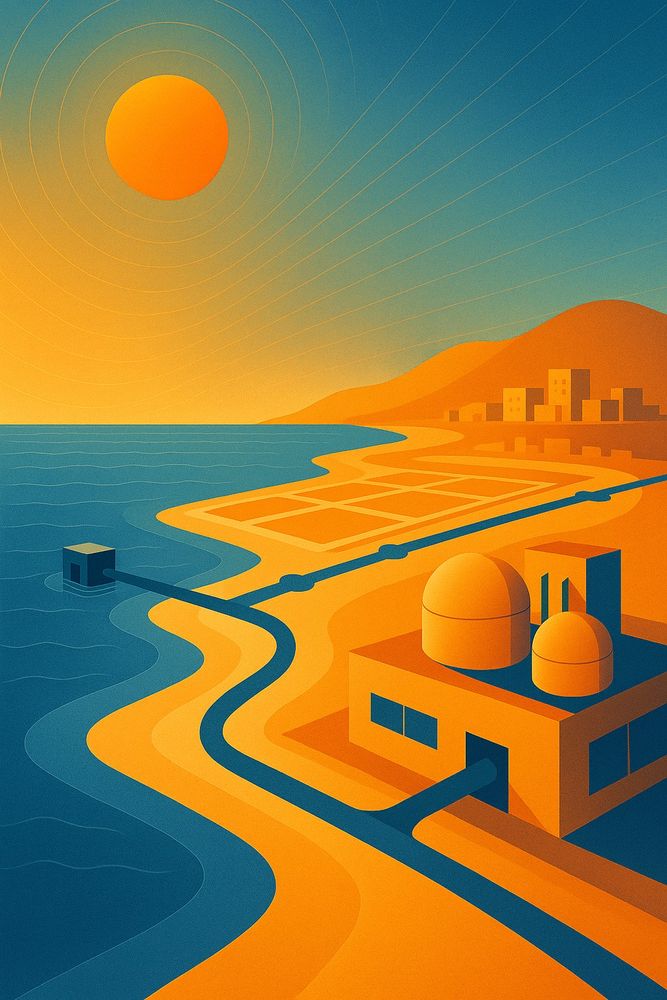
A Marisol-type system treats coastal cooling as urban coastal engineering, not just HVAC:
-> Intake & marine works
Civil engineers design low-velocity seawater intakes, screens and outfalls that avoid erosion, protect marine life and keep thermal plumes within regulatory limits. Bathymetry, sediment transport and storm surge all shape the layout.
-> Energy-landscape at the edge
Shallow solar brine ponds and crystallisation basins can be integrated into reclaimed land, port backlands or utility corridors. They double as desiccant “factories” and visible blue-green infrastructure, with clear footprints in m² per kW of cooling.
-> District-scale distribution
From the shoreline, buried pipelines carry tempered seawater or intermediate brine to building clusters (1–3 km range). Trench routing, easements, corrosion protection and leak detection become classic district-cooling design problems – just with saline media.
-> Building integration
On site, desiccant air handlers and salt-hydrate cold batteries sit in mechanical floors or basements. Structurally, they’re just tanks and air-handling units, but sized and detailed for higher densities and maintenance access rather than high pressures.
For Gulf cities, Red Sea industrial zones or emerging ports along the Sub-Saharan coast, this shifts the question from “How many chillers?” to “How do we masterplan a coastal cooling backbone?” – using marine works, land use planning and building services as one integrated system.
Investment
Collaboration
Partnership
Services