
🌊⚙️ Marisol for Coastal Compute Infrastructure
Data centers convert electricity into computation, and almost all computation into heat. For high-density AI clusters and proof-of-work campuses, heat rejection becomes an energy, water, siting, and permitting problem.
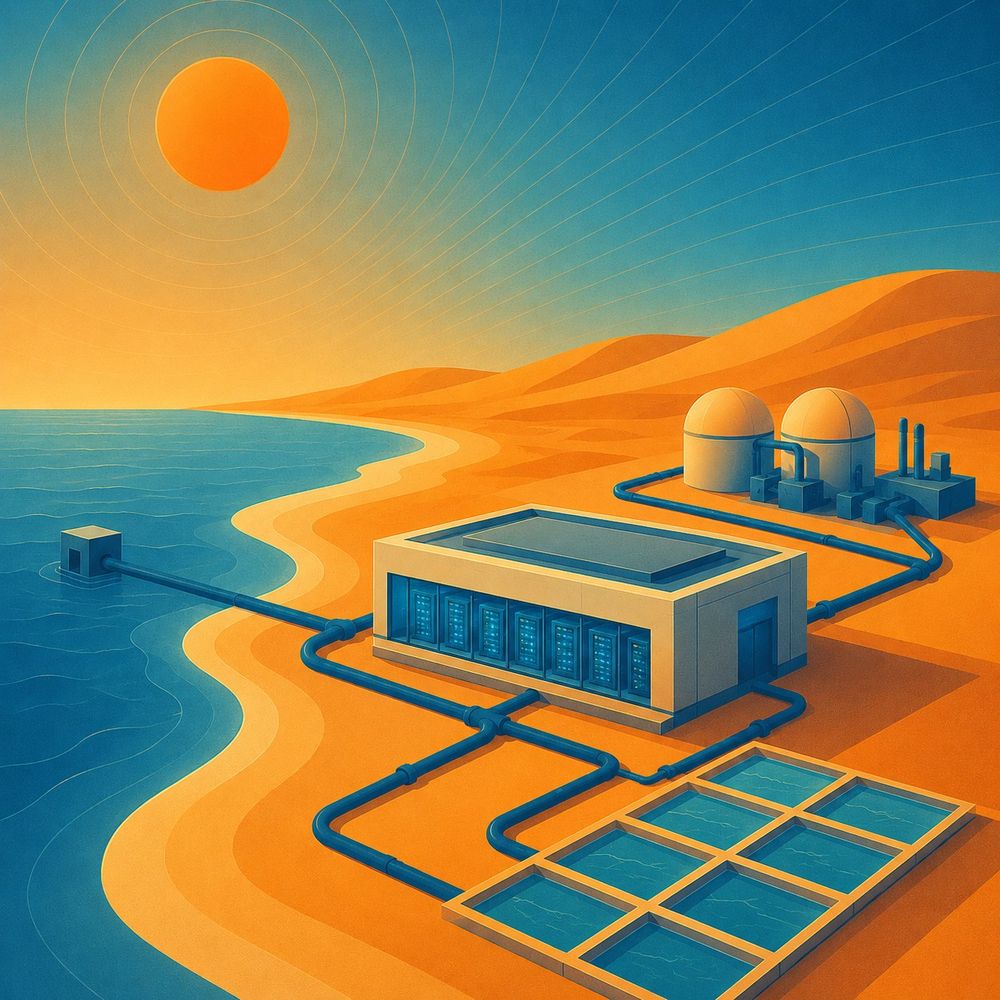
A Marisol-type architecture treats coastal compute as a layered thermal system.
1. Clean compute loop
Servers remain on closed, high-purity liquid loops. Seawater never enters the white space, protecting chips, cold plates, pumps, dielectric fluids, and electronics from chloride corrosion, scaling, microbes, and salt aerosols.
2. Marine heat-rejection loop
Outside the building, heat transfers to seawater through titanium, duplex stainless steel, or polymer-composite heat exchangers.
Q = ṁ × cp × ΔT
This makes ocean temperature, bathymetry, intake velocity, sediment, biofouling, and thermal-plume dispersion part of data-center engineering.
3. Thermo-chemical interface
In-situ electrochlorination can generate sodium hypochlorite from seawater for biofouling control, reducing transported chemical inputs. Hydrogen remains a safety-managed by-product.
At high compute densities, liquid-cooled servers can return water at 55-65 °C. This low-grade heat is useful for membrane distillation, liquid-desiccant regeneration, brine concentration, and water recovery.
The Marisol thesis:
Compute stays clean.
The sea takes the heat.
Chemistry governs the interface.
Waste heat supports water recovery.
The strongest use case appears where cheap or stranded power, coastal water scarcity, high heat density, and public-permission constraints converge.
In the right coastal regions, data centers can become integrated energy-water-compute infrastructure.
Investment
Collaboration
Partnership
Services