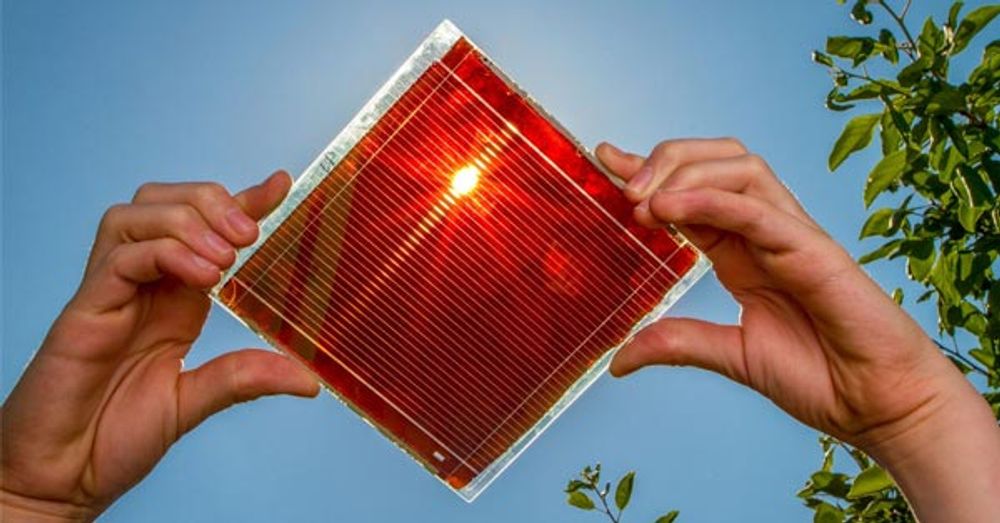
You may be wearing solar cells in a few years ... not panels on a rooftop, but thin films on your jacket and even your windows. That possibility comes from perovskites, a family of engineered materials that have had one of the steepest efficiency curves in the history of solar research. In just over a decade since the first lab cell in 2009, single-junction perovskite cells have reached efficiencies of 24–29%, already overlapping with commercial silicon's 22–27%. Stack them on top of silicon in what's called a tandem cell, and you push past what either material can do alone... certified tandem efficiencies have now crossed 35%. Beyond efficiency, perovskites can be made lightweight, flexible, and semi-transparent using low-temperature processes which opens up use cases silicon cannnot reach like facades, windows, portable electronics, and surfaces that can't bear the weight of conventional panels.
There are challenges. perovskites remain sensitive to heat, moisture, and UV exposure, and commercially available silicon panels are guaranteed to last 25–30 years - a bar most perovskite designs haven't cleared yet. Then there's lead - the most efficient formulations use small amounts of it, which keeps regulators watchful even as lead-free alternatives are explored. On the commercial side, China is clearly ahead...GCL Optoelectronics and UtmoLight both opened gigawatt-scale perovskite factories in 2025, with the latter already offering a 25-year output guarantee on deployed modules. Europe is catching up on the R&D and early commercial side - Oxford PV, a University of Oxford spinoff, was the first to ship commercial tandem modules. Perovskites probably won't replace silicon overnight, but they come with a lot of potential for use cases that are not in the purview of silicon.