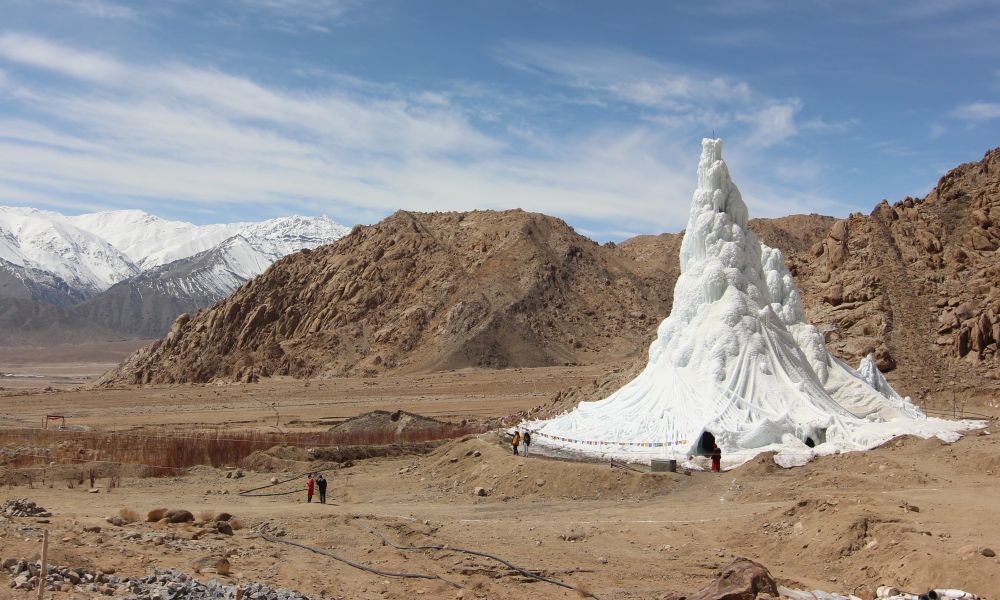
Did you know about the Ice Stupas of Ladakh, India? Ice Stupas are artificial glaciers built on the indigenous knowledge of Ladakhis. Naturally, ice forms in flat, horizontal sheets that melt quickly under the sun. Sonam Wangchuk, a mechanical engineer and teacher, noticed that ice stalagmites - vertical, cone-shaped ice - lasted much longer into spring than horizontal ice, since their shape exposes less surface area to sunlight. Building on this insight, he engineered a way to freeze glacial stream water vertically, piping it down through gravity-fed pipes so that pressure created towering vertical ice formations. These were aptly named Ice Stupas, as stupas are conical Buddhist shrines, Buddhism being the majoritarian religion of Ladakh.
The idea grew out of SECMOL, the education reform organisation Wangchuk founded in 1988. The first pilot rose in 2013, and by 2014 a full-scale version stood above Phyang village, storing winter meltwater that farmers could use to irrigate crops through the dry spring months. It was a modern engineering twist on an old Ladakhi practice - fittingly, the crowdfunding campaign that funded it was even called a "digital hala," after the traditional system of community labour used to build stupas.
The design has since travelled beyond Ladakh - Swiss architect Conradin Clavuot brought it to Switzerland through the MortAlive project, resulting in two ice stupas built there. Wangchuk's innovation has won several awards, including the Rolex Award for Enterprise in 2016.