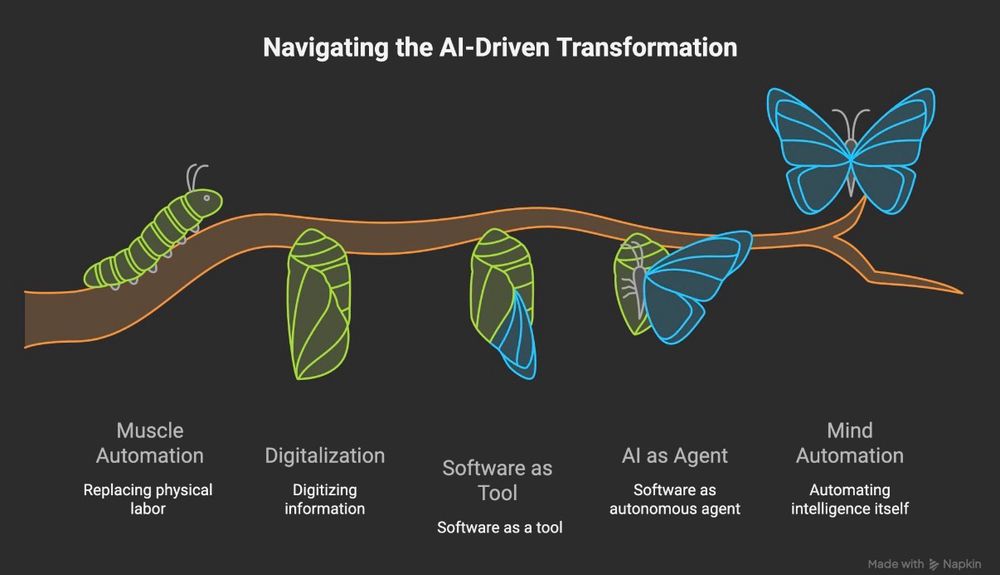
The shift your average 30-year-old is about to live through will dwarf what their parents experienced. Not slightly. By an order of magnitude.
If you're in your 30s today, your parents came of age between 1985–2000. Their transitions were still big, you know, analog to digital, landlines to smartphones, dial-up to broadband. But structurally, most jobs stayed recognizable. A lawyer in 1990 and a lawyer in 2020 still practiced law. Doctors diagnosed. Engineers engineered. The tools improved. The roles stayed intact.
What's beginning now is different.
We're moving from software as a tool to software as an autonomous agent. AI writes code. Generates research. Drafts legal arguments. Designs drugs. Robotics is leaving controlled factories and entering open physical spaces.
They saw the automation of muscle.
You're watching the automation of mind.
Previous revolutions replaced physical labor or digitized information. This one scales intelligence itself. And when intelligence compounds, adoption curves collapse. Twenty-five year transitions become two-to-five year transformations. Institutions move slower than software. Labor markets adjust slower than models improve.
Your parents had time to adapt.
This isn't a technology upgrade. It's a potential restructuring of how value is created and distributed. Stable career ladders will give way to repeated reinvention. Skill stacks could turn over every five to seven years. Entire industries shrink while new ones form faster than policy can respond.
That doesn't mean panic. It means clarity.
The question isn't whether this acceleration continues. The question is how we prepare psychologically, economically, and structurally for a world where intelligence is no longer scarce.
The future won't feel gradual. It will feel nonlinear. And nonlinear shifts require nonlinear thinking.
What skill or mindset shift are you betting on for the next five years?
The people who thrive in nonlinear times never stopped learning and never stopped connecting.