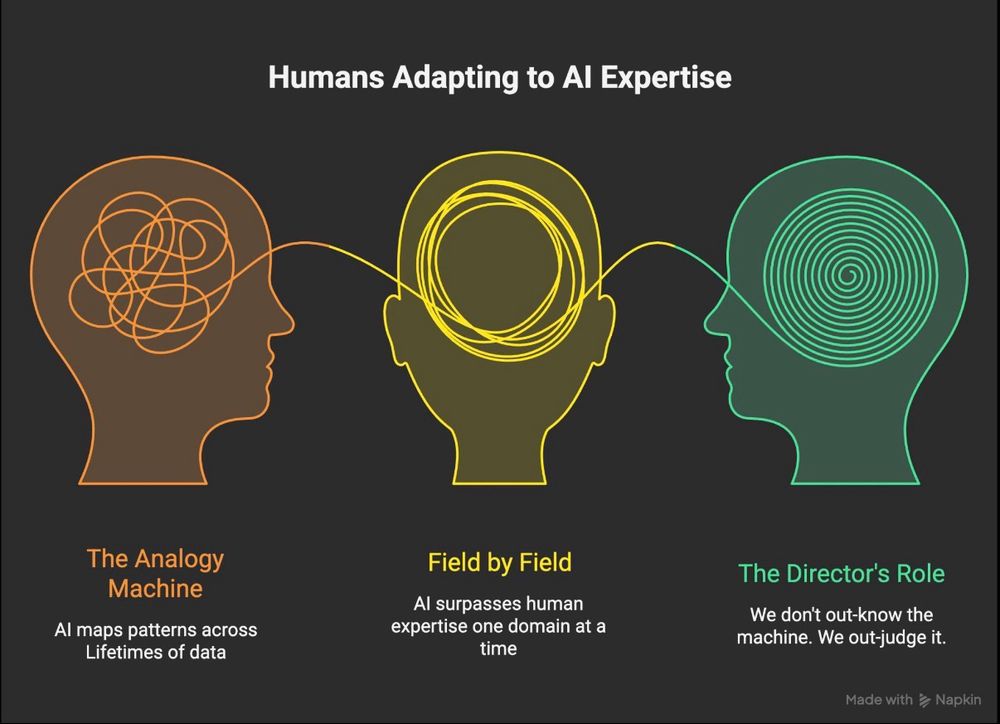
Stop thinking of AI as a "calculator." It’s much closer to an "Analogy Machine."
That reframe hit me while listening to Geoffrey Hinton, one of the actual godfathers of AI, break down how these models do "think."
Here's the reality: your brain has roughly 100 trillion synaptic connections. You are an architectural giant. But a long human life is only about 3 billion seconds of experience. We're built for depth. We're limited by time.
A modern LLM has about 1 trillion connections, which is 100x smaller than us structurally. But it's been trained on the equivalent of thousands of human lifetimes worth of patterns, language, and ideas. Fewer connections. Infinitely more experience. So what does it do? It gets ruthlessly good at finding patterns across everything it's ever absorbed.
Hinton's conclusion isn't a "Terminator" moment. It's quieter than that, and honestly more interesting. AI will surpass human expertise one field at a time. Mathematics. Protein folding. Legal analysis. Not all at once. Just steadily, domain by domain, as raw experience starts to outrun our architectural head start.
You know what that means for us? We don't need to out-know the machine. We need to out-judge it, wisdom.
AI can read every medical paper ever published. It still doesn't know what words to use when it's 2am and a family is scared. It can solve the equation but it can't tell you why that problem was worth solving in the first place. That part is still ours.
We're becoming Directors in a world full of the most capable Associates who ever existed. The question is whether we're ready to lead them well.
So I'm genuinely curious: if AI became the undisputed expert in your field tomorrow, what's the one human-only skill you'd lean all the way into?
#AI #FutureOfWork #HumanFirst #AIConsulting #TechLeadership
P.S. The fact that a model with fewer connections than the human brain can hold more functional knowledge than any single person ever could… that should humble us and excite us at the same time. Both. Simultaneously