Last week I was cutting the grass in a heat wave and it hit me: the thing most people are missing about AI's next decade was sitting right there.
I'd been listening to an interview with Emad Mostaque. His argument: economics has always been about managing scarcity, and intelligence has always been the scarcest resource. As intelligence gets closer to costing nothing, that foundation cracks. He calls it the Intelligence Inversion, a shift from scarcity to abundance.
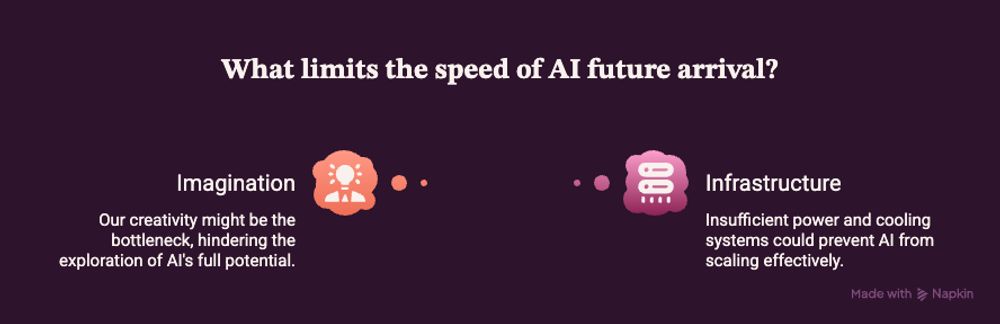
I realized abundance isn't free. It has a physical floor. Right now, that floor is heat.
Every chip running these models generates heat. There's a hard ceiling on how much you can pull out of a rack of silicon before the system throttles or fails. That ceiling has become the defining constraint in AI infrastructure. Not the algorithms. The thermodynamics.
For years, the AI story was about training, the massive compute to build a model. But training happens once or twice. Inference, running the model every time someone sends a prompt or an agent takes an action, happens millions of times a day. Inference is quietly becoming the bigger cost.
That shift is why a company called Etched is worth watching. They are betting that a chip built for 1 job, inference, could beat Nvidia's general-purpose GPUs. Their chip, Sohu, runs at a fraction of the power of a typical AI chip. Whether the bet pays off is unclear. A specialized chip is faster at its one job, but riskier if the model architecture shifts.
OpenAI joined AMD, Broadcom, Meta, Microsoft, and Nvidia this year in a consortium built to standardize the shift from copper to light based connections in AI data centers.
As AI agents take on longer, more autonomous work instead of single prompts, inference demand compounds. Every interaction needs power and generates heat. The abundant intelligence future, depends on solving that constraint at scale, with light: fiber optics.
We flesh suits aren't running out of ideas about what abundant intelligence could do. We might run out of ways to keep it cool.