For the last few years, the AI conversation has mostly been about models. Which one wins the latest benchmark.
Using AI looks like asking a question & getting an answer, then starting over. Working with AI is different. It means the system remembers your life, work, & increasingly decides which version of itself is right for the job.
That shift is already showing up in 3 places at once.
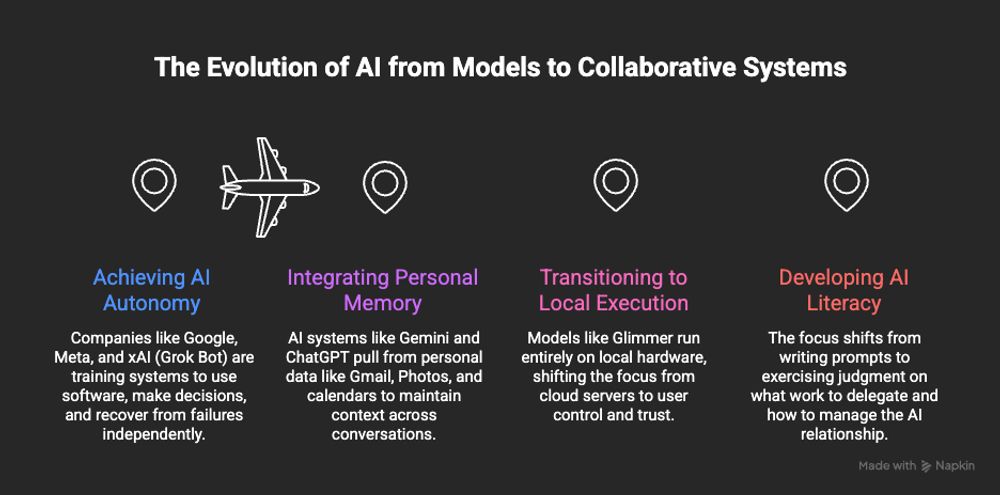
1st Autonomy. AI companies are training to actually do a job: use software, make decisions, fail, recover, try again. Cursor introduced a router that reads a request and decides which model should handle it. xAI launched Grok Bot, that picks its own model for a task. The model isn't the product anymore. The decision about which model to use is.
2nd Memory. Google's Gemini can now pull from your all your info to answer based on your actual life, not a generic one. For years, every AI conversation started from 0. That's no longer true, & it's easy to underestimate how big a change that is.
The 3rd piece is where all of this runs. Meta just released Glimmer, its Muse model small enough to run on a normal laptop, no cloud required. That sounds like a footnote. Once a system knows this much about you & can act without asking, where it runs becomes a question of trust. Some of this work, people want happening on their own machine.
Put those 3 together. AI is becoming more autonomous, more personal, & more local, all at once.
Knowing how to write a clear prompt is useful. It's no longer the hard part. The harder skill is knowing what work should be handed to AI, what context it needs, when it should act on its own versus when a person stays involved, & what you're comfortable letting it see.
That's a different kind of literacy. Not a world where people simply know how to use AI, but one where people understand how AI works, understand how they work, & build something in the space between the two.
The next few years are about AI & people together.