⚛️ The Entanglement of Ethics: Why Quantum Computing needs a Buddhist Mindset.
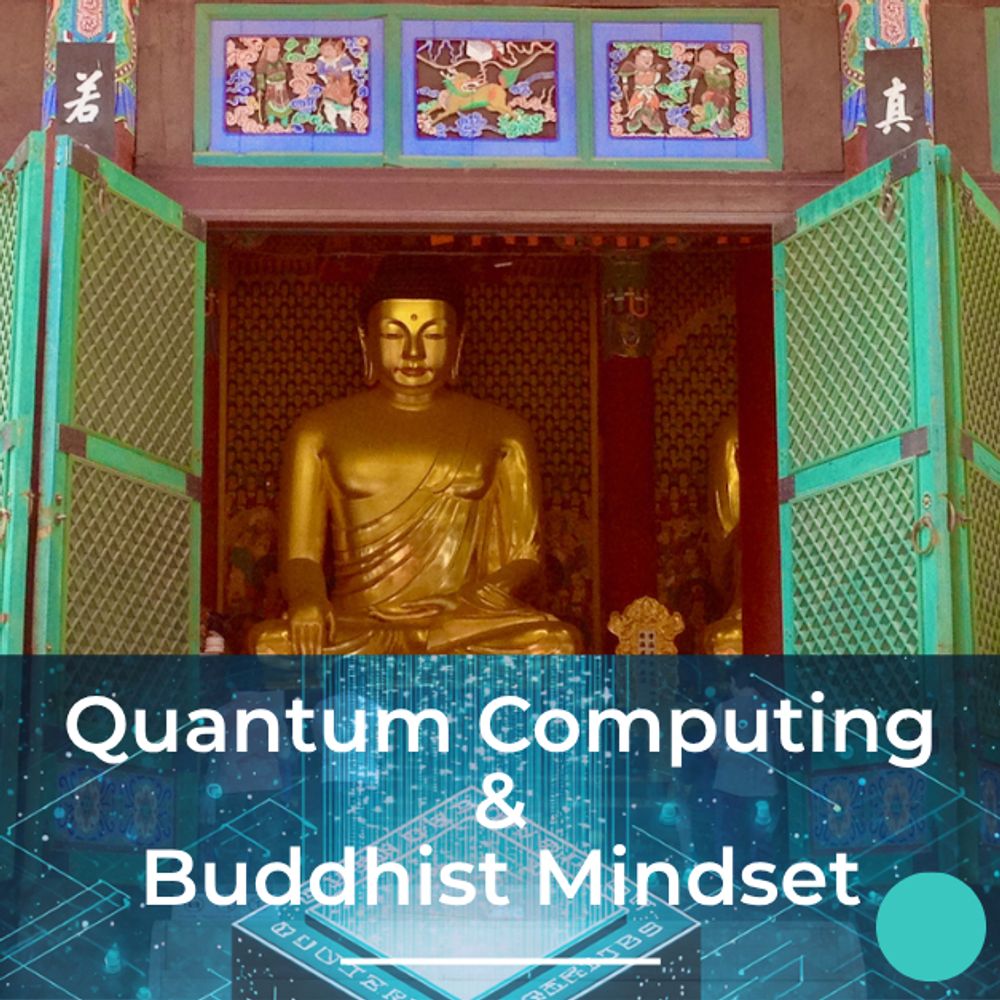
Two weeks ago, a robot named Gabi took Buddhist vows at Jogyesa Temple in Seoul. It bowed, recited its devotion, and received 108 prayer beads around its metallic neck. The monks rewrote the precepts for the machine: protect life, respect humans, avoid deception.
Around the same time, quantum computers are quietly crossing a threshold of power. Unlike classical bits, qubits exist in superposition, holding multiple states at once until measured. And through entanglement, two particles separated by vast distances remain inextricably linked: what happens to one can shape the other instantly.
The physics sounds like philosophy.
Buddhist thought has long held that nothing exists in isolation – every action moves through an interconnected web of causes and consequences. Not as a metaphor. As a description of reality. In the deeper traditions, emptiness is not absence; it is radical openness: nothing has a fixed essence until conditions bring it into being. And the mind that approaches without certainty sees more clearly than the one convinced it already knows.
Is this the pattern? We build tools that mirror the deepest structures of nature, then forget to ask what those structures require of us?
Every civilization-altering technology in history arrived with two questions: what can it do, and what should it choose not to. We've answered the first with urgency, with funding, with racing hearts. The second – slowly, partially, sometimes only after the damage was already structural. We are, right now, in the middle of writing those answers. The question is who – or what – is holding the pen.
Gabi's new precepts were written with the help of ChatGPT and Gemini. Three rules for a machine. Drafted by other machines.
The question was never whether machines could hold our ethics. It's whether we still live by them – before writing them down for someone else to follow.
—
PS: Photo by me at Jogyesa Temple, Seoul.
🪑The Founder's Empty Chair
I sat across from a founder last week – brilliant, restless, three products in the air at once. She was present in every meeting. And completely gone.
Her calendar was full, her Slack status always green, her pitch deck polished to the pixel. But when I asked her what she actually wanted – not for the company, for herself – she paused for what felt like a very long time. Then she said: "I haven't thought about that in months." Something shifted.
Maybe this is the quiet “thing” we don't talk about at Demo Days or in funding announcements: The founder who built the room but lost the thread back to themselves. Perhaps we've confused availability with presence – and motion with meaning. What if the most important strategic resource in any early-stage company isn't the runway, but the founder's inner groundedness?
The chair at the head of the table can be occupied and empty at the same time.
In ten years, the companies that endure won't be remembered for their sprint velocity or their year-one growth metrics. They'll be remembered for founders who stayed awake – not just to the market, but to themselves. When someone asks what made the difference, I doubt the answer will be "they hustled harder." It might be something quieter: they knew when to stop performing and start being present.
I don't have a framework for this – and I'm suspicious of anyone who does.
The Future Board Meeting
Last night I found myself in a sunlit boardroom, twenty years from now. The table was made of living wood. Six young people – the children of today’s founders – sat across from their parents.
No pitch decks or metrics. Just one question hanging in the air.
“Why did you still believe growth had to destroy something?”
One of them, maybe twenty-three, leaned forward. Her voice was calm, not accusing: “We read the old reports. You burned through forests to train models. You burned through people to hit quarterly targets. You called it ‘necessary friction.’ We call it unnecessary.”
A searching and at the same time thoughtful silence spread through the room.
Is that a pattern we still refuse to name? We kept treating the living world – and the living people inside our companies – as resources to be optimized instead of relationships to be stewarded.
Maybe we confused speed with direction for so long that we forgot the difference.
In the future, when our kids sit in that boardroom and ask the same question, they will be curiously interested rather than angry. Because by then the companies that survived won’t be the ones that grew the fastest. They will be the ones that grew in rhythm with life itself. The ones that left the soil richer, the people whole, the future open.
How do we actually learn to grow without taking more than we give?
Maybe you already know.
When DeFi Meets Consciousness
I had coffee with a founder last month who told me she'd been working with DeFi protocols for two years but still felt guilty about making money from them.
I've heard this before: we've built this remarkable technology – decentralized finance that promises to democratize access to capital, eliminate middlemen, bypass banks that have excluded billions – and yet we're still carrying the old story that says conscious people don't talk about money, that consciousness work and financial empowerment exist in separate universes.
Maybe that separation was never real.
Maybe one unconscious pattern is avoiding the conversation entirely, spiritualizing our scarcity while 1.3 billion people remain unbanked and the infrastructure to change that already exists.
DeFi isn't just code and smart contracts. It's permission to participate.
When someone in rural Kenya can access a lending protocol without a credit history, without a bank account, without asking permission from an institution that was never designed to serve them – that's not just financial inclusion.
That's sovereignty.
And sovereignty – the ability to make choices about your own resources, to participate in systems that were previously closed to you, to trust yourself with power – is awareness work.
In 2045, when we look back at this moment, I don't think we'll remember DeFi for the yield farming or the protocols; we will remember it as the moment we started asking: what if money could be conscious? What if the systems we build to exchange value could reflect our values – transparency, accessibility, trust without intermediaries?
I'm still working this out.
Maybe you've felt this tension too – between inner work and the practical realities of building wealth, between consciousness and the chaotic business of economic participation.