There's a particular kind of moment that doesn't come round often: a few minutes of clicking that genuinely decide something in the real world. This is one of them.
The Kardashev Institute's Civitas pitch — our work building real carbon sequestration infrastructure — is a finalist for a £10,000 prize at Reset Connect 365. The whole thing comes down to a public vote, and it closes 23 June.
If we win, that £10,000 starts funding the creation of the Stiftung — the international legal entity that will permanently hold Civitas's sequestration assets. That's not a marketing budget. It's the foundation everything else gets built on. And winning carries something beyond the cheque: the attention that comes with it is the kind that opens doors to further funding and partners — doors that don't open the same way for a pitch nobody's heard of.
None of that depends on us being the loudest or best-funded team in the room. It depends on enough people deciding, in the next few days, that three minutes is worth spending.
Here's what those three minutes look like:
1. Create an account at
app.inspired.ch
2. Join the Reset Connect 365 Community:
app.inspired.ch/community/3m...
3. Find the Kardashev Institute pitch and cast your vote
That's the whole ask. If this is the kind of work you want to see exist in the world, this is one of the rare chances where your say actually counts toward whether it does.
And if you've got one more minute after that — send this to two or three people who'd feel the same way. That's how these get won.
Investment
Hello everyone,
We are submitting Civitas to the Reset Connect 365 London 2026 competition on Inspired.
The world currently treats carbon removal, sustainable fuels, food production, land restoration, and economic growth as separate challenges. Civitas is our attempt to bring them together into a single system designed to regenerate ecosystems while creating economic value.
We believe that human development and environmental recovery should work together, not against one another. After hundreds of hours of research, planning, and revision, we are excited to share the project publicly and would love to hear your feedback.
If the idea resonates with you, please take a look at the pitch deck, vote for Civitas, and share it with others who might support the project.
Every vote helps us move one step closer to turning the concept into reality.
Thank you for your support.
drive.google.com/file/d/1BV8P...
Investment
One square kilometre of regenerative desert coast — built from nothing but sunlight, seawater and sand — can draw down roughly 80,000 tonnes of CO₂ a year. The question was never whether it is possible. It is whether anyone funds and verifies it honestly.
The voluntary carbon market is not failing because companies stopped caring about the climate. It is failing because the instrument was built wrong.
The logic of the offset — buy a credit, claim a tonne — has collapsed under scrutiny. Microsoft has pulled back from large offset purchases; airlines including KLM and Delta have faced legal challenge over offset-based green claims. What firms are walking away from is not climate accountability. It is a mechanism they can no longer defend.
The Kardashev Institute's position is that this is a structural problem, not a moral one. A credit whose price floats, and which is matched to a project chosen after the fact, cannot carry the weight of a serious claim.
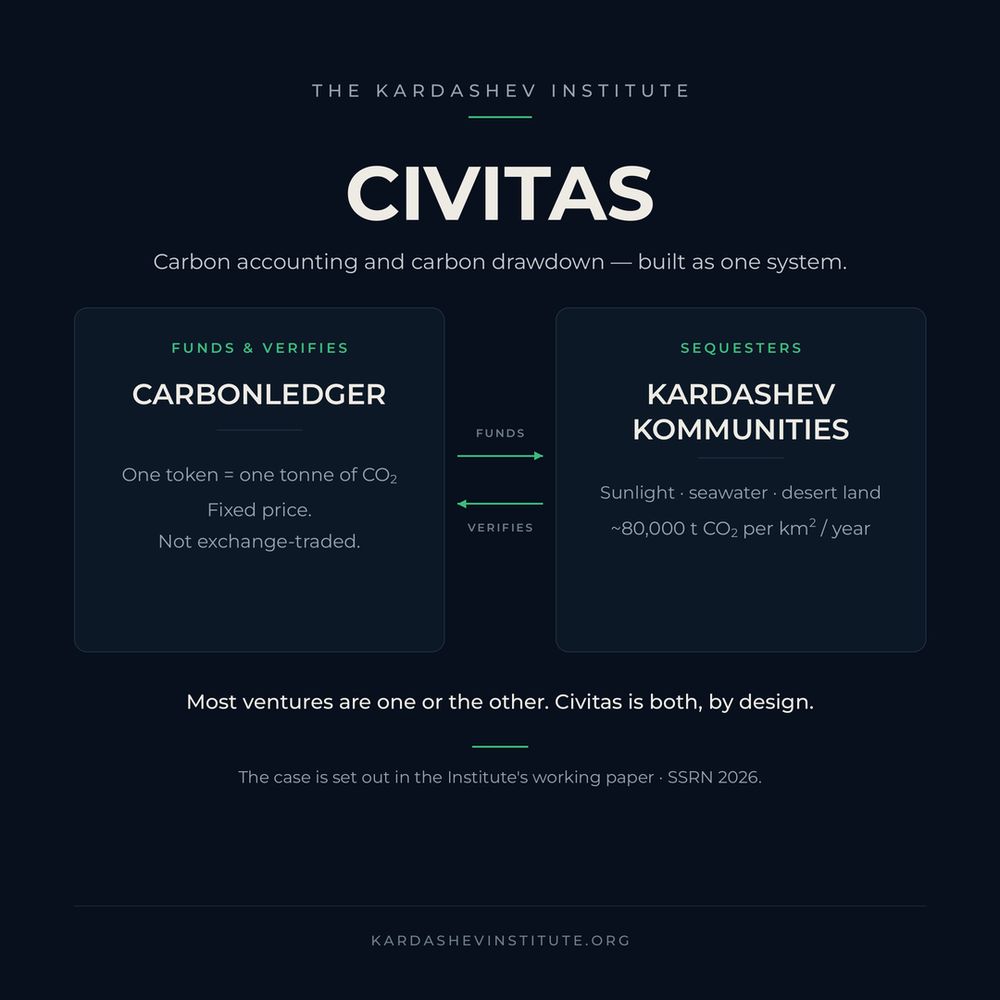
Civitas, the Institute's response, is built as the alternative — and as a single system, not two products.
CarbonLedger is the accounting and funding layer: a non-speculative protocol that issues one token for one tonne of CO₂ actually emitted, at a fixed price, never listed on an exchange.
Kardashev Kommunities is the physical layer: regenerative coastal-desert settlements made from sunlight, seawater and desert land — each square kilometre modelled to draw down around 80,000 tonnes of CO₂ a year.
One funds and verifies. The other sequesters. Most ventures are one or the other. Civitas is both, by design.
The full argument is set out in our working paper, Carbon Market Failure and the Case for a Non-Speculative Offset Protocol (SSRN, 2026;
papers.ssrn.com/sol3/papers....).
We will be at Reset Connect London on 23–24 June, ExCeL, during London Climate Action Week. If you build, fund or govern the transition — and you have watched the offset market lose its credibility — come and find us, or message us here.
[email protected]
Investment