Consulting • United Kingdom
Follow
We've created what I hope is an understandable guide to creating ToCs. Feel free to download the document, read, and send those questions over. Link is in the comments below
Consulting • United Kingdom
Follow
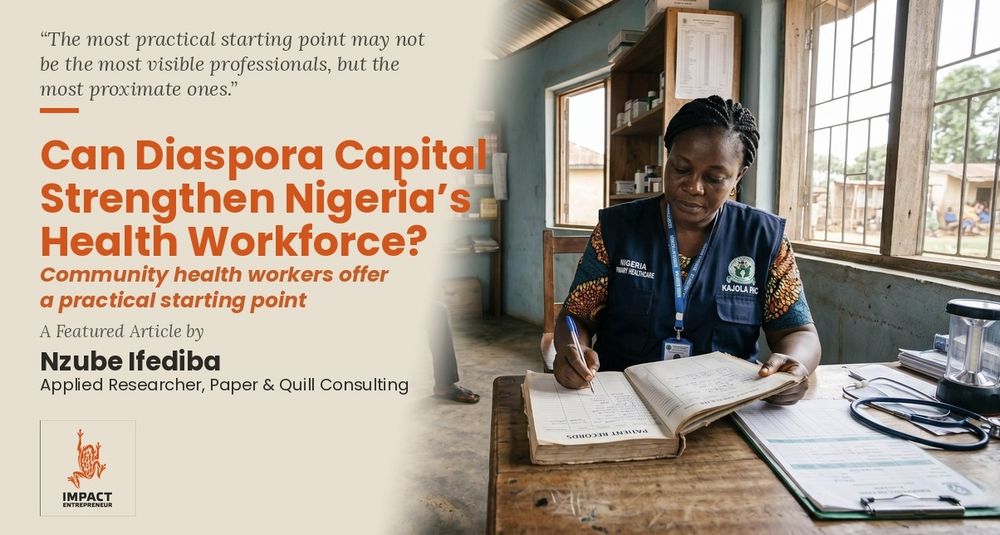
our founder just published a piece on
#impact entrepreneur on how diaspora capital can strengthen the primary care workforce and meet SDGs.
Link is in the comments.
Consulting • United Kingdom
Follow
#IRIS+ is a system developed by the Global Impact Investing Network to help investors measure and manage impact.
Think of it as a catalog of standardized metrics that investors can use across sectors. Examples in global health might include:
Number of patients served
Number of health facilities supported
Access to affordable care
Jobs created in health services
How is it different from DALYs?
DALYs try to answer “how much health did we improve?”, while
#IRIS+ tries to answer: “what did this investment actually do, and can we track it consistently?”
The Disability-Adjusted Life Year focuses on outcomes (health gained, life years saved) and relies on complex modeling and assumptions.
The IRIS+, on the other hand, focuses on outputs and
#indicators (what happened, what was delivered) and standardized, trackable metrics across investments. This makes it a no-brainer for investors with portfolios across multiple cause areas. But it is not without a tradeoff. More on that later.
Consulting • United Kingdom
Follow
The Disability Adjusted Life Year does a pretty good job in measuring welfare improvement. When used for multiple interventions, it gives us a bird's eye view of cost effective interventions.
The tradeoff is that some donors may find this bird's eye view very broad. For example, the Cost/DALYs averted can tell you about cost effective interventions, but it cannot give context on the nature of welfare improvement, or help you rank which improves welfare the most.
And it's because there is no universal way to do so, the context varies. For example, do you value an intervention that eliminates chronic debilitating suffering in an adult over one that prevents neonatal mortality? Or vice versa?
These are philosophical questions with no single answer.
Organizations like Givewell think deeply about such questions. So the DALY isn't a core impact metric for them. Instead, they use different welfare measures like life years saved, extreme misery averted, adult lives saved, and so on.
Consulting • United Kingdom
Follow
If you’re trying to compare very different health problems, say for example, malaria vs. maternal health vs. road injuries, you need a common unit.
That’s what a DALY is.
In simple terms, a DALY represents one year of healthy life lost. It combines two things:
Years of life lost (YLL) due to early death, and Years lived with illness or disability (YLD)
So, DALY = YLL + YLD
As a welfare metric, the Cost/DALY averted is a good
#outcome proxy, much more than output data on reach and coverage, i.e., number of patients, number of clinics, and all.
This is because with DALYs, you are not just counting the number of patients treated; you are measuring actual improvement in health and life expectancy.
For example, a school feeding program in Kenya reaches about 600,000 students a day. A very impressive output, but is it a good proxy for impact? Not quite.
A good outcome proxy would be DALYs from anemia averted as a result of the feeding program. Anemia is notoriously common in U5s and 5-9s in Africa. So to construct our DALYs, we collect data:
1. Prevalence rates of anemia in primary schoolers in Kenya
2. Effectiveness rates of SFPs on iron stores. For this, RCTs/meta-analyses are the standard.
3. GBD weighting of mild/moderate iron deficiency anemia
4. Mortality rates of anemia in this cohort
5. Disease duration
6. Life expectancy in Kenya
With these, we calculate total DALYs averted and then discount based on certain assumptions: attribution, dead weight, external validity, and so on.
The
#WorldBank, WHO, and global health grant makers use this metric to compare multiple health interventions across countries. Interventions that avert the most DALYs per dollar are naturally ranked higher as best buys.
However, like any modelling, the Cost/DALY averted has its blind spots, more on that later.
Consulting • United Kingdom
Follow
I’ve made a series of posts on the potential uses of welfare-adjusted metrics in impact investing.
Now, a bit of devil’s advocate. Are there cons/drawbacks to doing so? Of course there are:
1. Measurement uncertainty can mislead decisions
Welfare metrics often rely on modelling assumptions, generalized evidence, and imperfect data. When translated into
#investment decisions, this can create a false sense of precision. For example, a model might suggest one investment is “more impactful,” when in reality the difference is driven by assumptions. This can be risky in capital allocation.
2. Monetising welfare is ethically and methodologically contested.
Converting DALYs into money requires assigning a value to human life or health. This often involves metrics like the Value of a Statistical Life (VSL)/Value of a Life Year. Critics argue this can oversimplify complex social outcomes, embed ethical biases, and create uncomfortable comparisons (e.g., whose life is “worth more”)
3. Risk of distorting investment behaviour.
If investors optimise for welfare-adjusted
#returns, they may prioritise easily measurable interventions, favour short-term, quantifiable outcomes, and avoid complex or systemic investments.
4. High implementation costs
Robust welfare measurement requires data collection, modelling expertise, and ongoing validation. Unlike outputs, these are not easily standardised. And because most funds are not set up to run quasi–cost-effectiveness analyses across portfolios, this becomes a barrier to adoption.
5. Attribution still matters
Even with contribution analysis approaches, welfare estimates still depend on assumptions about causal pathways and uncertain
#counterfactuals. Critics argue that without strong
#attribution, welfare metrics risk becoming well-informed guesses rather than decision-grade metrics.
Consulting • United Kingdom
Follow
In my opinion,
#impactinvesting seems to hold a tension between impact and financial returns, although some organizations argue otherwise.
For example, the Rockefeller's Foundation, in its famous impact investing handbook, argues that: “Impact is not simply a third dimension of the financial risk/return relationship that can somehow be optimized.
#Impact may occur independently from or not be directly correlated to risk and return.”
Discussion for another day.
Moving on, I think one way to reduce the tension/tradeoff between impact and financial return is to incorporate impact into financial returns, as a single metric.
For example, what if welfare metrics such as DALYs or income gains are converted into monetary units and used to inform financial returns?
Here are possible pros:
1️⃣ Better informed decision-making
Since welfare-adjusted metrics provide additional insight into:
• long-term
#sustainability of interventions
• real value created for end users
• hidden risks (e.g., negative externalities)
They can improve the quality of information provided to LP.
2️⃣ Identifying Hidden Risks
Ignoring welfare can create blind spots.
For example, welfare-adjusted analysis can help identify products that scale but don’t improve outcomes, interventions with unintended negative effects, and solutions that fail adoption over time.
Early recognition can protect financial performance, reputation, and long-term portfolio value.
3️⃣ Improving Capital Efficiency
In global health and development, welfare metrics are used to compare impact per dollar, and guide resource allocation.
#Impactinvestors could apply a similar lens by asking:
• Which investments generate the most welfare per unit of capital?
• Where are diminishing returns setting in?
• Are we funding the highest-impact opportunities?
If impact weighted IRRs are used at the portfolio level to benchmark impact efficiency, and guide thematic allocation, could they ease up trade-offs, while still improving overall impact performance?
Thoughts?
Consulting • United Kingdom
Follow
I’ve nursed this question for a while.
It is validating to read a confirmation: the most recent paper by Long-term Impact Association shows that while non-profit organizers measure
#impact for accountability to both funders and beneficiaries, non-NGO
#investors measure impact to communicate performance to investors.
It's a world of difference.
By prioritizing accountability, NGOs (particularly high-impact NGOs) tend to reiterate their ToCs through adaptive feedback from beneficiaries.
By prioritizing communication, non-NGO investors lean towards reportage that is standardized, scalable, and easy to benchmark. While this has the advantage of increasing the frequency of reports, the downside is a tendency to report for report's sake, i.e., non-NGO investors are less likely to use data to inform management decisions.
I'd like to learn more from evaluators in the impact investment space. The link to the report is in the comments.