Recent posts
It's Giving season!
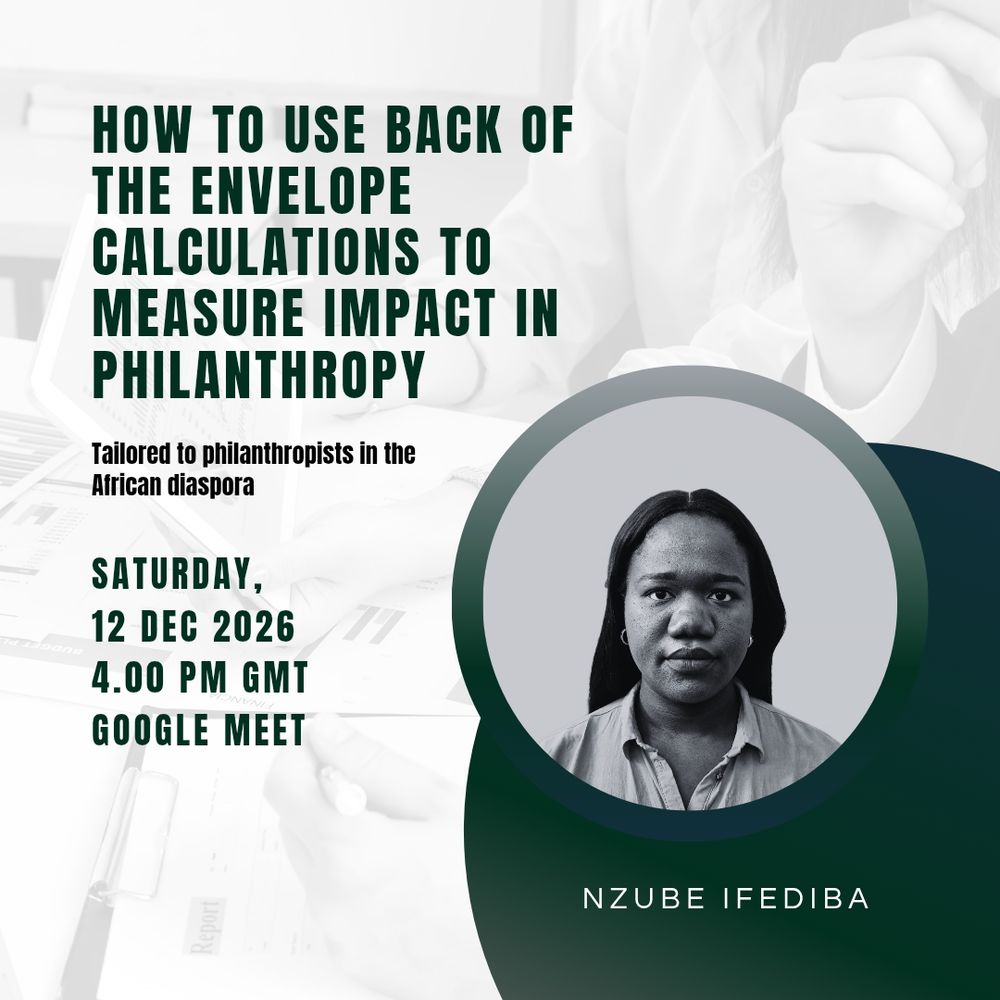
Budget plays a big role in our donation decisions, but how often do we think about impact?
By quantifying the impact of our donations the way we do costs, we can cut waste and move donations to areas with high impact and high additionality.
In this class, you will learn how to use Excel spreadsheets to:
✅ Build shallow models to estimate social return on investments.
✅Understand concepts like additionality and counterfactual from your donations.
✅Make good guesses with limited data and high uncertainty.
Registration in comments
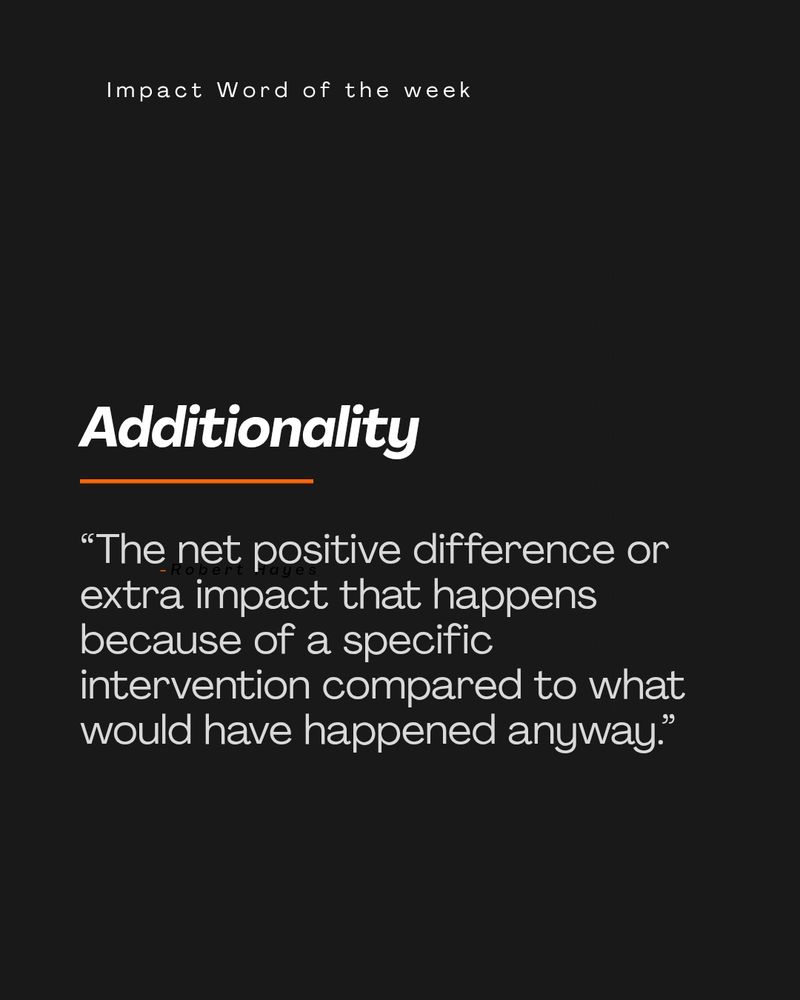
Impact word for the week. Additionality. Additionality often goes in hand with neglectedness. The more neglected an area, the higher the additionality of your philanthropic capital.
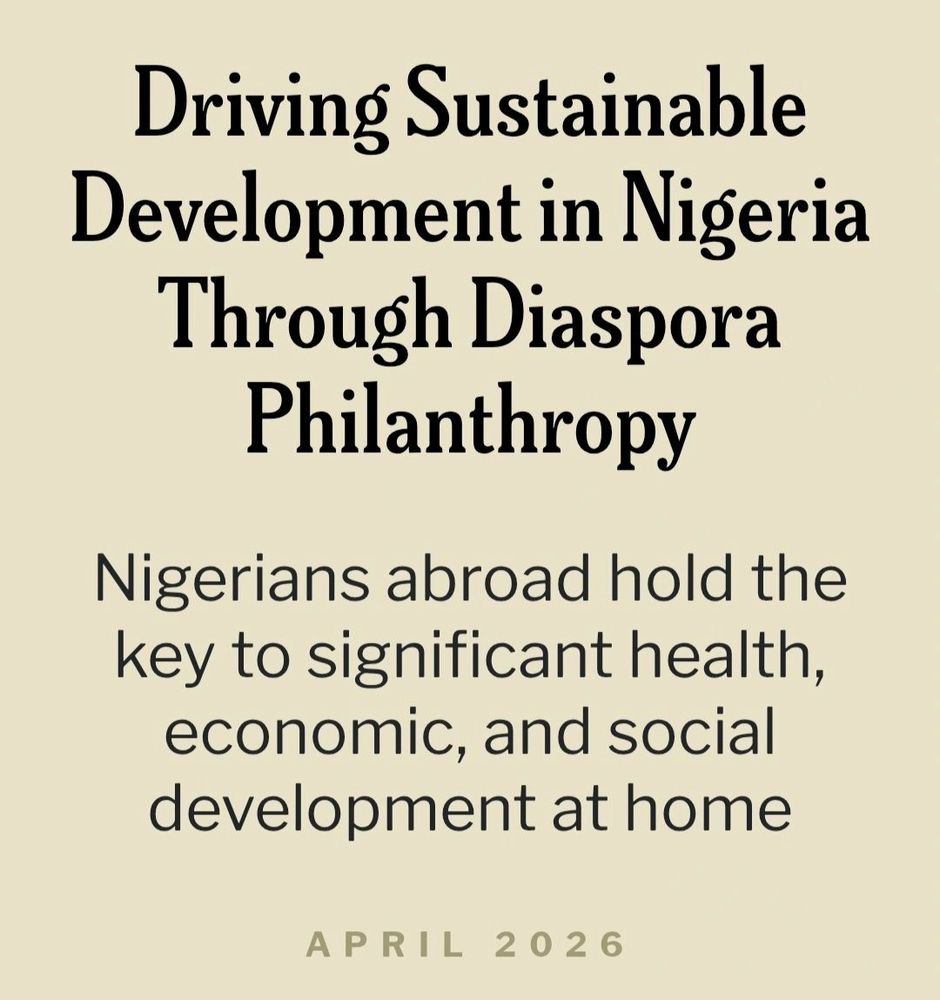
We are counting down to giving season and I'm bringing this article back.
The report by FP Analytics and Ford Foundation on the state of Nigeria’s diasporan philanthropy describes what we know about the potential of remittances:
✅They have risen steadily in the last two decades, far outpacing overseas aid.
✅They will continue to do so well into the future.
However, the impact measurement field is still very green and largely untapped.
According to the report, the limited availability of high-quality information on socioeconomic data makes it very hard for philanthropists and impact investors to measure the impact of their giving.
What’s more, a lot of philanthropists still see their giving as an informal thing, and not the strategic tool that it is.
How can we help Africa's diaspora give more intentionally and strategically?
"All models are wrong, few are useful."
But again, we all are modelling one way or the other; whether implicit or explicit, we all do it.
And when it comes to philanthropy most of us are more implicit than we would be if it were other things like say, investments, for example.
And even gut giving is some form of modelling, just non-contestable.
Anyway, models get a lot of flak and it's understandable, it can quickly become unwieldy, fast, maybe a tad ludicrous even.
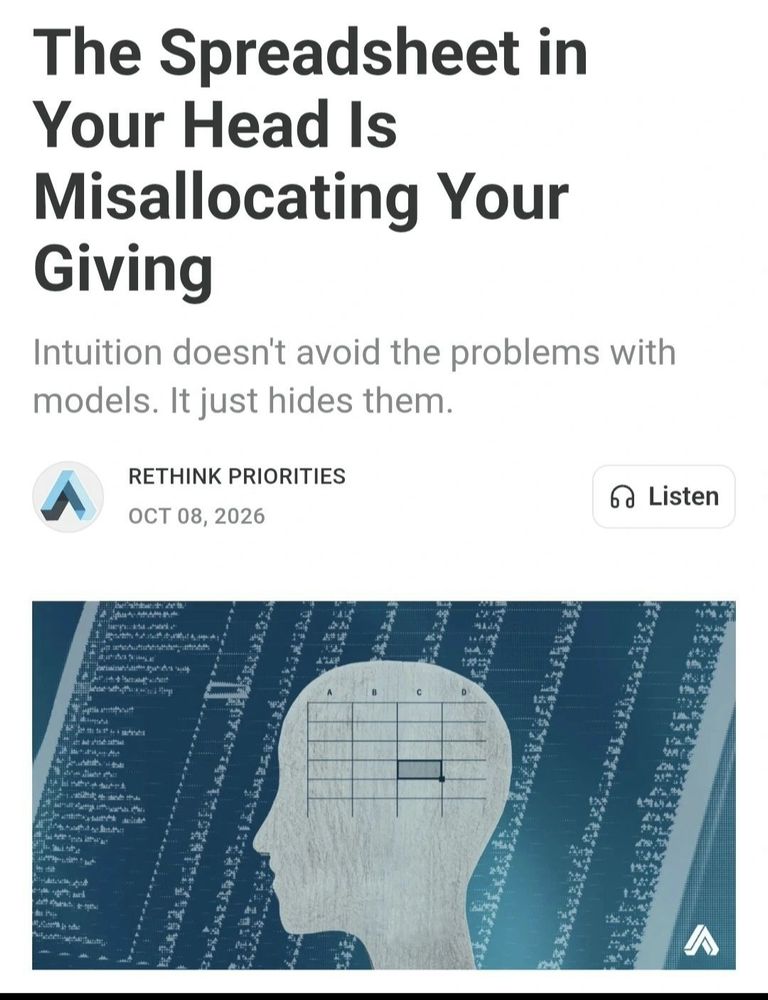
But the idea, as the folks at Rethink Priorities argue, is to calibrate your reasons.
And you can't calibrate what you aren't explicit about. Link's in the comments below.
In 2013, Warren Buffett's son, Peter, wrote this scathing oped for the NYT.
A brave thing considering.
There were difficult pills to swallow in this piece. Check these out:
"Philanthropic Colonialism. I noticed that a donor had the urge to “save the day” in some fashion. People (including me) who had very little knowledge of a particular place would think that they could solve a local problem."
"Often the results of our decisions had unintended consequences.."
"Because of who my father is, I’ve been able to occupy some seats I never expected to sit in..... All are searching for answers with their right hand to problems that others in the room have created with their left."
"As more lives and communities are destroyed by the system that creates vast amounts of wealth for the few, the more heroic it sounds to “give back.” It’s what I would call “conscience laundering” "
His solution? Humanism.
"I’m really not calling for an end to capitalism; I’m calling for humanism. My wife and I know we don’t have the answers, but we do know how to listen. As we learn, we will continue to support conditions for systemic change."
"It’s time for a new operating system. Not a 2.0 or a 3.0, but something built from the ground up. New code."
And the piece ends here. A cliff hanger really. Kind of frustrating.
What should humanism look like?
A more urgent and pertinent question: what should humanism in the age of AI look like?
A lot of what he wrote 13 years ago are more important now than then. For example, AI will very likely create vast amounts of wealth for a concentrated few.
If we aren't mindful, philanthropy could just be a tool for conscience laundering.
But if used properly, philanthropy could be used to build social cohesion in an increasingly polarised world.
What will it take for this to happen?
Curious to know your thoughts.
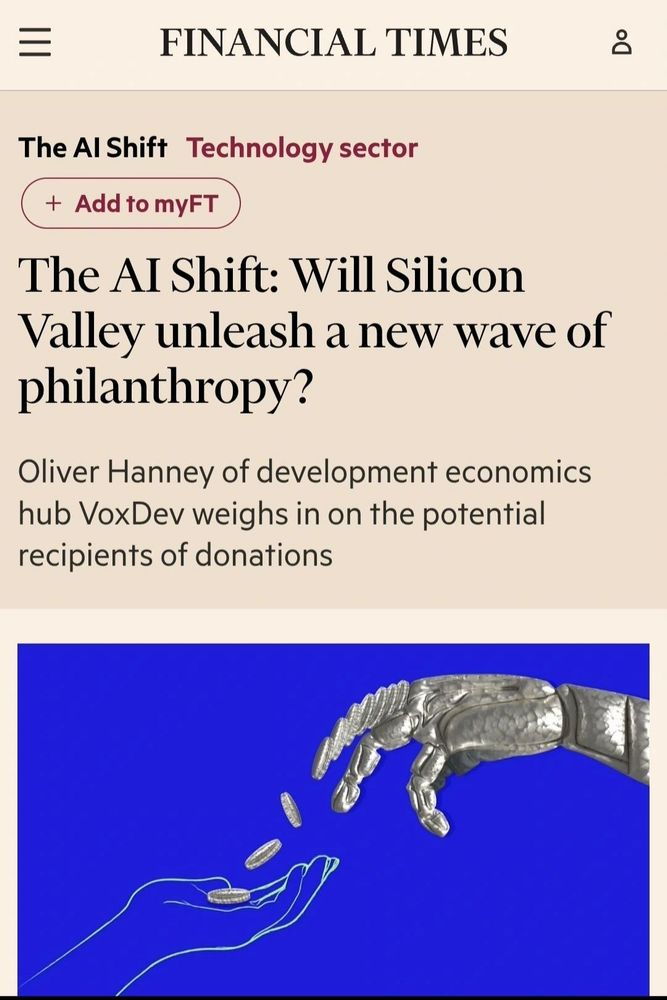
Just read this piece in Financial Times by Oliver Hanney of VoxDev. So in summary:
⚫The new wave of philanthropy will prioritize people who move fast and are really good at communicating their vision to others. So think VC style philanthropic funding.
⚫But he cautions that most problems in LMICs may not be solvable with a start-up mindset.
⚫He also adds that there will be a focus on global health and development, local institutions in LMICs, capacity building and systems strengthening.
⚫When asked about what development economists can do differently in the AI era, he said that development economists need to move fast in disseminating ideas and research: a typical research cycle can take up to five years.
I agree with all these. But to add...
🟠Development economists need to invest more time vetting and championing other methods for rigourous evidence besides the RCT.
🟠Don't get me wrong the RCT has been useful but we do need other methods.
Why?
🔴I'm very concerned that this current wave of philanthropic will put a disproportionate emphasis on quantitative causal evidence i.e. RCTs because of their affiliation to EA.
🔴If this happens, there is a real tendency to fall into the legibility trap, as described by Justin Steele, where elite grantmakers already in the space are favoured over people most closest to the problem.
🔴So basically, what we have is the third wave doing no different from the first two waves, by reinforcing Global North dominance in global philanthropy.
Three months ago, I attended a summer party with Startup Grind London.
First off the venue was designed in such a way that you had to walk up to talk to people. Think poseur tables, sweating prosecco glasses, canapes, ambient music.
A three hour event with just 30 minutes for a formal welcome from the hosts.
For sure there were loads to talk about. First time I also heard the word superconnector. Lol
A lot of people wanted to know what I did and when I said I'm into philanthropy and impact measurement they couldn't see how that related to startups, until I said something in lines of:
"You know like how with VC/startups, if your product is bleeding money without gaining traction you would know?
In philanthropy it's different because the feedback is not really there, so a donor can keep funding stuff that isn't working. That's where I come in, to make sure philanthropic capital works hard."
And some folks were like "monitoring and evaluation?"
And I said, "not really, more of counterfactual thinking."
Which then opened up another stream of conversation on additionality and impact.
I quickly figured that drawing comparisons with VC helped folks understand some impact terminologies better.
So with my latest Substack, I tried to make that comparison, using VC lingo to help explain core impact concepts.
Link's in the comments.
This article on legibility barriers by Future Matters gives insight into how AI donors view legibility.
In summary, most of the interviewed donors think AI governance is illegible. By illegibility they mean:
🛑A lack of explicit causal models that show how activities lead to policy reform. Cost-effectiveness models were not a criterion for legibility.
🛑A lack of a counterfactual, i.e., proof that this wouldn't have happened without their donations
🛑Policy/advocacy interventions have an inherent legibility problem, i.e., it is difficult to attribute impact, because impact is diffuse and in most cases, covert.
Then there are also these bits:
✅Most donors relied on well-known EA grantmakers for donation decisions
✅In the absence of causal models, they use these as proxies for impact: trusted grantmakers, tangible outputs, and measurable short-term goals.
All in all, this research confirms the practical suggestions Jack Lewars🔸 made in his article: How Not to Fundraise from Anthropic Staff.
Cue: do not send a cold email.
Instead
✅See if you can be rated by grantmakers/evaluators trusted by AI employees
✅If this doesn't work, no harm in building your internal legibility through a solid ToC, M & E, and a strong portfolio of evidence on your program’s effectiveness and cost-effectiveness.
✅Scale/room for more funding matters
✅Layer awareness campaigns, i.e., think pieces, podcasts, etc., on top of these.