GenAI has a groupthink problem, and it’s built directly into our architectures.
We’ve been designing multi-agent AI systems like corporate committees. We build sequential chains (Agent A talks to Agent B) or drop multiple models into a shared chat room and assume debate leads to truth.It doesn't.
It creates The Swarm Echo. ❌
Because LLMs are autoregressive, every generated token is tethered to the context before it. The moment specialized agents share a conversational history, their independent perspectives degrade. Early assumptions subtly contaminate the entire chain, turning cross-examination into a biased echo chamber.For high-stakes analysis, we don't need agents that get along. We need structural conflict.
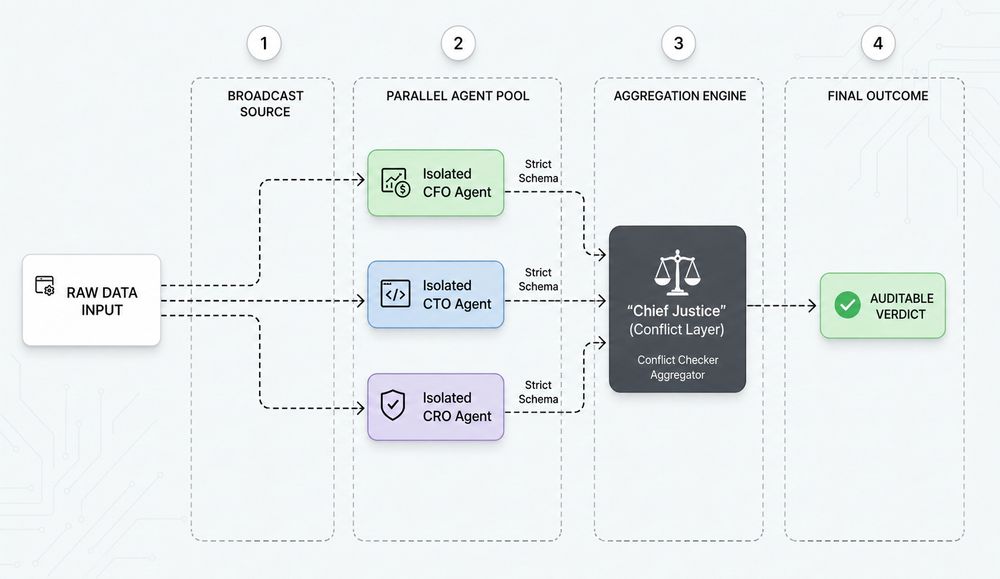
To break this loop, I built Octochains, an open-source Python framework designed for Parallel Isolated Reasoning.Instead of fluid conversation, Octochains broadcasts inputs to specialized expert nodes simultaneously. Every agent operates in a private thread with zero awareness of its peers, outputting strictly into typed data schemas.Once independent views are locked in, a deterministic verification layer, the Conflict Checker, audits the reports to map logical contradictions and incompatible timelines.
We can scale this using two algorithmic strategies:
1️⃣ The Global Prompt-Matrix: A cost-effective, single aggregator call to catch systemic contradictions across multiple agents.
2️⃣ Multi-Threaded Pairwise Audit: Running programmatic, bilateral combinations [ N * (N - 1) ] / 2 to eliminate context-window degradation and achieve hyper-focused precision.
When building complex multi-agent workflows for corporate due diligence, legal risk, or diagnostics, consensus is a liability. Embracing raw, unfiltered friction between agents doesn’t break the system, it’s how we uncover the truth.
💡 Want to move beyond groupthink? The architecture, cookbooks, and framework are completely open-source.
👇 Check out the GitHub link in the comments to explore Octochains and drop a star! ⭐