Data Scientist | Al Eucator @Coursera| MAS Architecture•Germany
8Following5Followers
I am a Data Scientist and AI Engineer based in Konstanz, Germany, specializing in LLMs, multi-agent reasoning, and agentic data retrieval at exorbyte. Leveraging my M.Sc. in Computer and Information Science, I also serve as a global AI Course Author on Coursera, mentoring over 80,000 learners in advanced data analytics. Driven by open-source innovation, I am the creator and architect of ‘Octochains’ - a lightweight Python framework designed for parallel, collaborative AI reasoning.
GenAI has a groupthink problem, and it’s built directly into our architectures.
We’ve been designing multi-agent AI systems like corporate committees. We build sequential chains (Agent A talks to Agent B) or drop multiple models into a shared chat room and assume debate leads to truth.It doesn't.
It creates The Swarm Echo. ❌
Because LLMs are autoregressive, every generated token is tethered to the context before it. The moment specialized agents share a conversational history, their independent perspectives degrade. Early assumptions subtly contaminate the entire chain, turning cross-examination into a biased echo chamber.For high-stakes analysis, we don't need agents that get along. We need structural conflict.
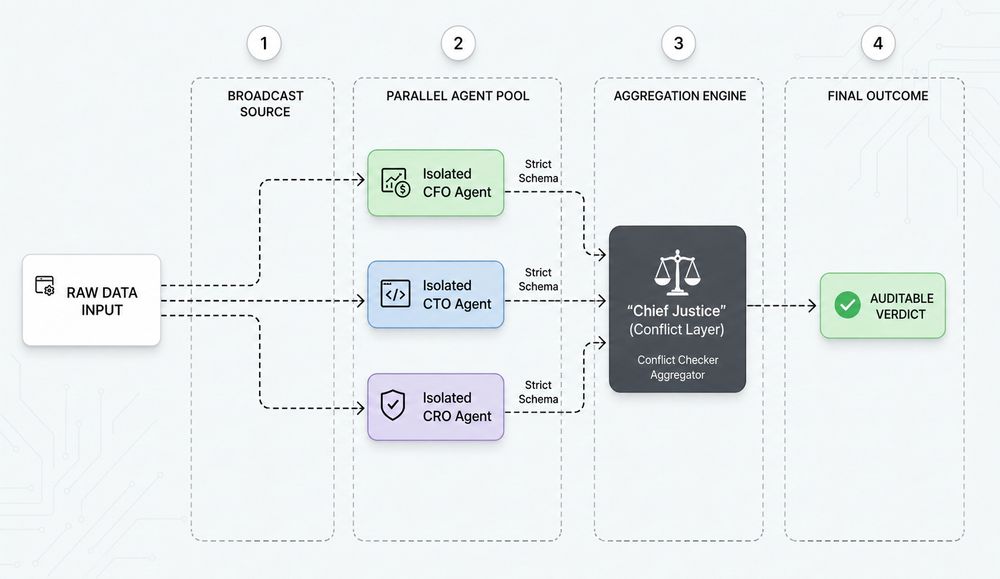
To break this loop, I built Octochains, an open-source Python framework designed for Parallel Isolated Reasoning.Instead of fluid conversation, Octochains broadcasts inputs to specialized expert nodes simultaneously. Every agent operates in a private thread with zero awareness of its peers, outputting strictly into typed data schemas.Once independent views are locked in, a deterministic verification layer, the Conflict Checker, audits the reports to map logical contradictions and incompatible timelines.
We can scale this using two algorithmic strategies:
1️⃣ The Global Prompt-Matrix: A cost-effective, single aggregator call to catch systemic contradictions across multiple agents.
2️⃣ Multi-Threaded Pairwise Audit: Running programmatic, bilateral combinations [ N * (N - 1) ] / 2 to eliminate context-window degradation and achieve hyper-focused precision.
When building complex multi-agent workflows for corporate due diligence, legal risk, or diagnostics, consensus is a liability. Embracing raw, unfiltered friction between agents doesn’t break the system, it’s how we uncover the truth.
💡 Want to move beyond groupthink? The architecture, cookbooks, and framework are completely open-source.
👇 Check out the GitHub link in the comments to explore Octochains and drop a star! ⭐
Multi-agent decision-making is only as good as its conflict analysis.
In high-stakes AI architectures, the real challenge isn't getting agents to talk; it's managing the contradictions, mismatching opinions, and logical conflicts that emerge when specialized agents analyze a complex problem from different perspectives.
Today, Octochains is taking a massive step forward in solving this. With the launch of v0.3.0, we are introducing our first Official, Domain-Agnostic Aggregators built specifically to handle conflict analysis and synthesis for enterprise-grade reasoning.
Meet our new official aggregators:
1. The ConflictChecker: This aggregator strictly audits isolated expert reports for conflicts, logical contradictions, and incompatible claims in the agents' opinions. To ensure absolute, reproducible auditability, it supports multi-threaded execution to run exhaustive pairwise comparisons across your agent pool.
2. The Synthesizer: It takes the raw opinions of multiple isolated experts, automatically removes redundancies, and merges the collective intelligence into an executive-ready report.
Octochains remains completely lightweight and developer-first. You bring your own LLM function (whether it's OpenAI, Anthropic, or running locally via Ollama), define your expert pool, and let our parallel engine handle the multi-threaded execution and strict evaluation.
Every single decision leaves a 100% traceable log of expert rationale , keeping your workflows fully aligned with the strict compliance needs of the EU AI Act.
I need your brutal feedback on `octochains` pitch.
This weekend I have been practicing and putting together a 2-minute presentation video in Canva to make sure the delivery hits hard and looks completely professional. But I need a fresh, unbiased set of eyes to critique the final cut.
For context: `Octochains` is an open-source Python framework built for high-stakes decision-making, like auditing legal contracts or analyzing business strategies. Standard multi-agent setups run into critical failures like cognitive tunnel vision and logical contamination, where agents bias each other and amplify hallucinations down a sequential chain. Octochains solves this through Parallel Isolated Reasoning, forcing expert nodes to evaluate data in total isolation before a centralized aggregator agent synthesizes clean, traceable insights that are fully compliant with the EU AI Act.
I’ve managed to pack the entire problem, architectural solution, and compliance metrics into this 2-minute format. Now, I want you guys to tear it apart.
Can you give me your honest thoughts on these 3 questions?
- Is the explanation of the attention mechanism and multi-agent flaws clear, or does it feel too compressed?
- Does the transition into traceability and the EU AI Act feel smooth?
- Since I edited this in Canva, how is the visual pacing and overall delivery?
Watch the 2-minute clip below and don't hold back in the comments. Tell me exactly what needs fixing! 👇