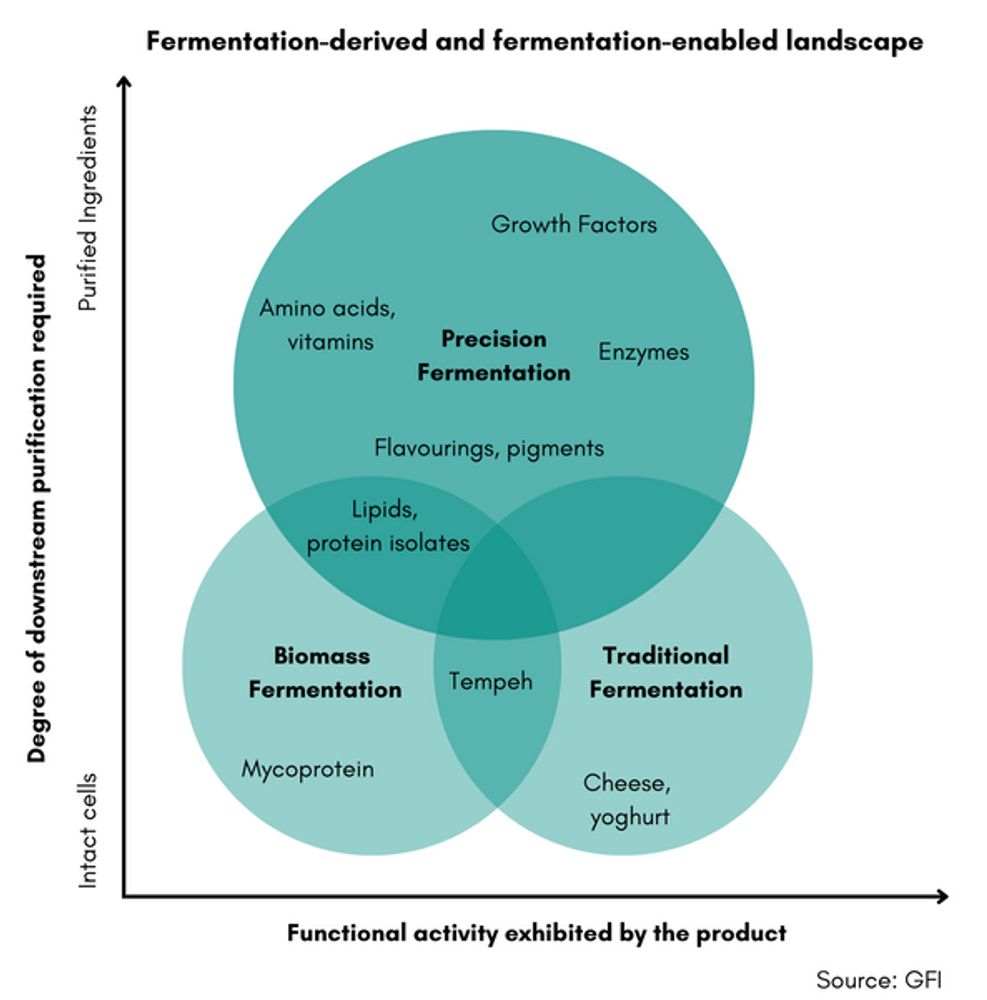
Precision and biomass fermentation may be two of the most commercially important food technologies to watch.
Continuing with the series on what could be on your plate by 2035, this category stands out because it may scale faster than most consumers realize.
Both rely on microorganisms such as yeast, fungi, or algae to produce food more efficiently than traditional agriculture, but they solve different problems. Precision fermentation uses microbes to produce specific ingredients like dairy proteins, fats, or enzymes, while biomass fermentation grows the microbial biomass itself as a protein source.
What makes this space so compelling is not just the science, but the economics behind it. The market is projected to grow from $6.9B in 2026 to $75.8B by 2035, driven by demand for animal-free proteins, advances in biotech, and the need for more efficient food systems.
Unlike many food technologies, fermentation does not always require consumers to change behavior. Precision fermentation can improve ingredients already used in familiar products, while biomass fermentation can create scalable protein with far less land, water, and time than conventional agriculture.
That may be what makes this category so commercially powerful. It can improve the food system underneath existing products while also creating entirely new protein sources.
Could fermentation become one of the most scalable food technologies simply because consumers may barely notice it?