Interesting read for understanding behavior change related to AI usage.
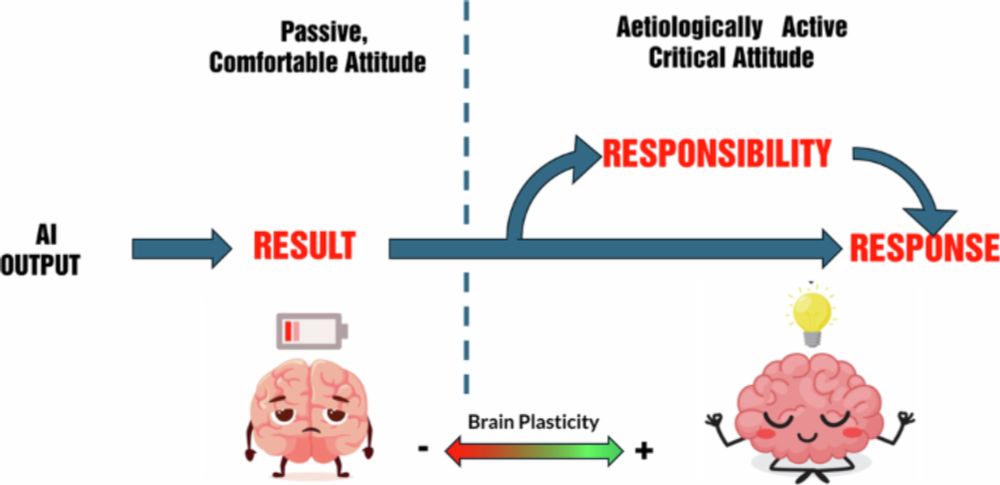
This article argues that the long-term effects of AI on people will depend less on the technology itself and more on how we use it. The authors say that if people rely on AI passively (copying answers, accepting suggestions without checking, etc.) this could weaken the kinds of mental effort that help maintain neuroplasticity, critical thinking, and decision-making over time. By contrast, using AI actively (questioning, refining, co-creating, and evaluating its output) could help preserve or even strengthen cognitive function. They present this as a hypothesis grounded in neuroscience concepts about brain plasticity, not as something already definitively proven.
The central idea is their “3R principle”: Results, Responses, Responsibility. AI produces results, outputs that may be useful, but do not carry understanding or meaning on their own. A human turns those into responses by interpreting them in context and judging their consequences. Responsibility is the crucial third step: humans must remain accountable for values, choices, and meaning, because current AI systems don't have moral understanding or genuine intentionality. The authors argue that outsourcing too much to AI risks not just “cognitive offloading,” but also a deeper erosion of agency and judgment.
Their practical conclusion is that the 3R principle should be treated as a kind of cognitive hygiene for the AI age. They especially emphasize education: students, researchers, workers, and everyday users should be taught to interrogate AI output rather than surrender to it. The article’s bottom line is not “don’t use AI,” but use it in a way that keeps your brain engaged and keeps moral responsibility with you.
www.nature.com/articles/s44...