Berkeley News recently covered what is being described as the largest study of generative AI use among undergraduates, and I think the most interesting part is not only the cheating angle.
More than 95,000 students across 20 research-intensive public universities were surveyed. Around two-thirds said they used GenAI, almost 40% used it monthly or more, and at least 9% of AI users reported using it to cheat.
That part matters, of course. But the bigger issue may be what the study reveals about uneven access and uneven AI fluency.
Low-income students, female students, and racially underrepresented students were less likely to use AI. In a job market where AI proficiency is already becoming an advantage, that gap could become another layer of educational and professional inequality.
For universities, the challenge seems to be bigger than detecting cheating. They need to define what responsible AI use looks like in practice, update assessments so they measure real understanding, and make AI literacy accessible to all students, not only to those who already have the confidence, time, or resources to experiment with these tools. Blanket bans are becoming harder to defend and at the same time, treating AI as a neutral productivity tool is too simplistic.
This is becoming a skills issue, an ethics issue, and an access issue at the same time.
news.berkeley.edu/2026/05/21/t...The largest study of AI use by undergrads is in, revealing disparities in access — and in cheating - Berkeley News
Researchers found that how students use (and misuse) AI varies by subject and by socioeconomics.
Google announced Google Health Coach, its new AI-powered Fitbit coaching experience, a few weeks ago, and I was really excited to see the impact.
Now that early testers have shared their feedback, the picture is mixed, but very telling.
The good: people seem to like it when the coach connects the dots. When it remembers that you were sick, adjusts your workout plan, explains a bad readiness score without making you feel worse, or turns raw sleep and activity data into something actually usable.
The less good: it still makes mistakes. Some users reported hallucinated workouts, forgotten activities, inaccurate food logging, too much generic AI encouragement, and a general feeling that you still need to check what the “coach” is saying.
For years, wearables have been great at collecting data, but not always great at changing behaviour. AI coaching could change that, because it moves from “here is your data” to “here is what you might do next.”
Assuming the product continues to improve and these errors are fixed, it will be interesting to observe, from a behavior-change perspective, whether people will let an AI influence how they rest, eat, train, recover, or interpret their own bodies.
Amazon’s latest move with Alexa for Shopping feels like a useful signal for where consumer behavior may be heading. The interesting part is not simply that people can ask AI to compare products or track prices. It is that shopping is moving from search to delegation.
Amazon is now embedding conversational AI directly into the shopping flow, with tools that can remember context, compare products, track prices, suggest items and even automate some actions. At the same time, consumer research from Adobe and NRF shows that people are already using AI for product research, reviews, recommendations and deal-finding.
This creates a new question for brands because for years, the challenge was: how do we win the consumer’s attention? But if AI agents start filtering options before people even see them, the challenge becomes: how do we become understandable, trustworthy and selectable by the systems consumers rely on?
That could shift the value of product content in a big way. Clear descriptions, transparent pricing, strong reviews, availability, return policies, may become even more important than polished campaign language.
From a consumer behavior perspective, this is interesting because the decision journey may no longer be entirely human-facing. Part of persuasion may happen before the shopper reaches the shelf, the website, or the ad.
www.aboutamazon.com/news/retail/...Meet Alexa for Shopping, your personalized, agentic AI assistant on Amazon
Amazon brings together Rufus and Alexa+ to create ‘Alexa for Shopping’ on the Amazon Shopping app and website.
PwC recently shared its Global Health Report, looking at the main forces reshaping healthcare in 2026 and beyond.
The report points to a clear shift: healthcare is moving from reactive, hospital-centred care towards more predictive, decentralised and consumer-driven models.
AI is one of the main drivers. PwC describes it less as a standalone tool and more as future infrastructure for healthcare, embedded into workflows, risk monitoring, diagnostics, scheduling and care coordination. But the trust gap is still significant: only 24% of healthcare leaders say they are confident in privacy regulation compliance, and only 19% say the same about AI regulation compliance.
Another major theme is data liquidity. Health systems already generate huge amounts of data through clinical records, wearables, home monitoring, apps and patient-reported outcomes, but much of it still sits in silos. PwC argues that the next step is not just collecting more data, but making existing data usable, secure and interoperable across the system. The cybersecurity gap is also striking: only 2% of healthcare leaders report having fully implemented cyber resilience actions.
The consumer side is also changing quickly. According to PwC, 70% of people now use health technology such as wearables, apps or virtual services monthly, and 65% want a healthcare system built more around prevention than treatment. At the same time, while 72% received care in a doctor’s office in the past year, only 34% say this would be their preferred setting in the future.
The report also covers the rise of value-based care and the growing focus on healthspan, not just lifespan. Globally, healthspan now lags lifespan by 9.6 years, which makes prevention, ageing in place, remote monitoring and integrated care models increasingly important.
Overall, it’s a useful read for anyone following the intersection of AI, digital health, consumer behaviour and healthcare system redesign.
www.pwc.com/gx/en/issues...I had one of those weeks where the pace of AI made me feel both excited and slightly exhausted. Lately I’ve been finding it harder and harder to keep up with everything that’s happening. Just this week, I switched from Claude Design (which basically punished me with a week in jail for actually using the product :)) to ChatGPT Images 2.0 within days.
As a marketer, I try to stay current not only for myself, but also for my clients. At this point, following AI starts to feel like a second job. There’s always a new model, a new feature, a new tool, a new wave of people saying “this changes everything", "the death of graphic design", "the death of coding", etc. And if I’m honest, it’s starting to create a bit of anxiety and major FOMO because it’s getting genuinely hard to tell what matters, what is just noise, and what is actually worth learning deeply enough to adopt.
I’m curious how others are handling this. How do you decide what to follow closely, what to test casually, and what to ignore? And how do you stay informed without letting the pace of AI take over your whole mental space?
Interesting read for understanding behavior change related to AI usage.
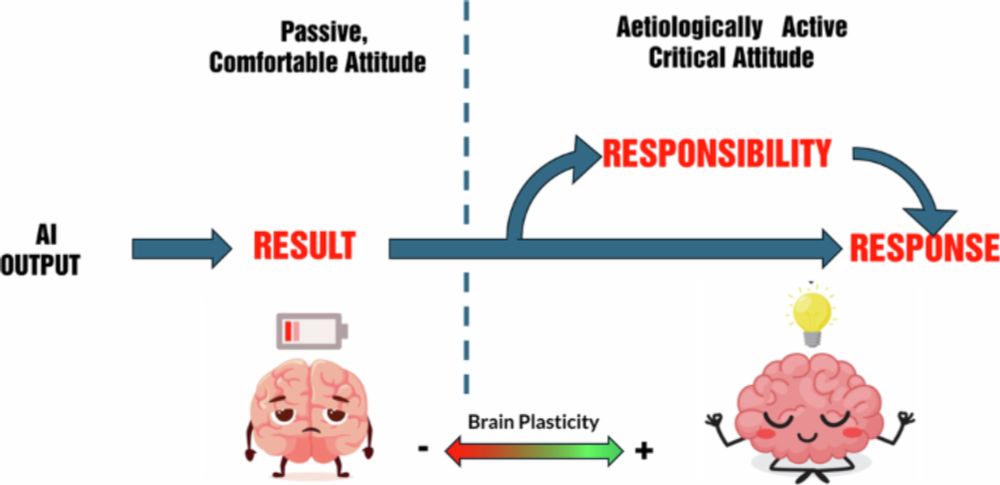
This article argues that the long-term effects of AI on people will depend less on the technology itself and more on how we use it. The authors say that if people rely on AI passively (copying answers, accepting suggestions without checking, etc.) this could weaken the kinds of mental effort that help maintain neuroplasticity, critical thinking, and decision-making over time. By contrast, using AI actively (questioning, refining, co-creating, and evaluating its output) could help preserve or even strengthen cognitive function. They present this as a hypothesis grounded in neuroscience concepts about brain plasticity, not as something already definitively proven.
The central idea is their “3R principle”: Results, Responses, Responsibility. AI produces results, outputs that may be useful, but do not carry understanding or meaning on their own. A human turns those into responses by interpreting them in context and judging their consequences. Responsibility is the crucial third step: humans must remain accountable for values, choices, and meaning, because current AI systems don't have moral understanding or genuine intentionality. The authors argue that outsourcing too much to AI risks not just “cognitive offloading,” but also a deeper erosion of agency and judgment.
Their practical conclusion is that the 3R principle should be treated as a kind of cognitive hygiene for the AI age. They especially emphasize education: students, researchers, workers, and everyday users should be taught to interrogate AI output rather than surrender to it. The article’s bottom line is not “don’t use AI,” but use it in a way that keeps your brain engaged and keeps moral responsibility with you.
www.nature.com/articles/s44...The brain side of human-AI interactions in the long-term: the “3R principle” - npj Artificial Intelligence
Neuroplasticity is shaped by how humans interact with AI. We argue that passive, uncritical, reliance on AI may weaken activity-dependent brain plasticity and erode cognition, whereas active co-creati...
Another day, another time I’ve been genuinely blown away by AI.
This week, I uploaded my daughter’s dental X-rays and investigations and asked ChatGPT to help me understand what was going on. It explained what the issue seemed to be, why it mattered, what kind of orthodontic treatment might follow, and what questions I should ask at the appointment.
Then I went to the orthodontist and honestly, the consultation validated almost everything. Of course, I would never use ChatGPT instead of a specialist. But as a tool for understanding, preparing, and making medical conversations less intimidating, it felt incredibly powerful.
We talk a lot about AI for productivity, writing, coding, automation but moments like this make me think one of its biggest impacts may be something simpler: helping ordinary people understand expert worlds a little better.
This Guardian piece on Anthropic is worth a read. It’s about the company keeping its newest cybersecurity-focused model, Claude Mythos, out of public release because it reportedly uncovered thousands of software vulnerabilities, many still unpatched, and Anthropic says the risk of misuse is too high.
We talk a lot about how fast AI is moving, but this is a good reminder that capability without careful deployment can become a risk very quickly.
www.theguardian.com/technology/2...Anthropic keeps latest AI tool out of public’s hands for fear of enabling widespread hacking
AI company says purpose of its Claude Mythos model is to bolster defenses against hacking in common applications