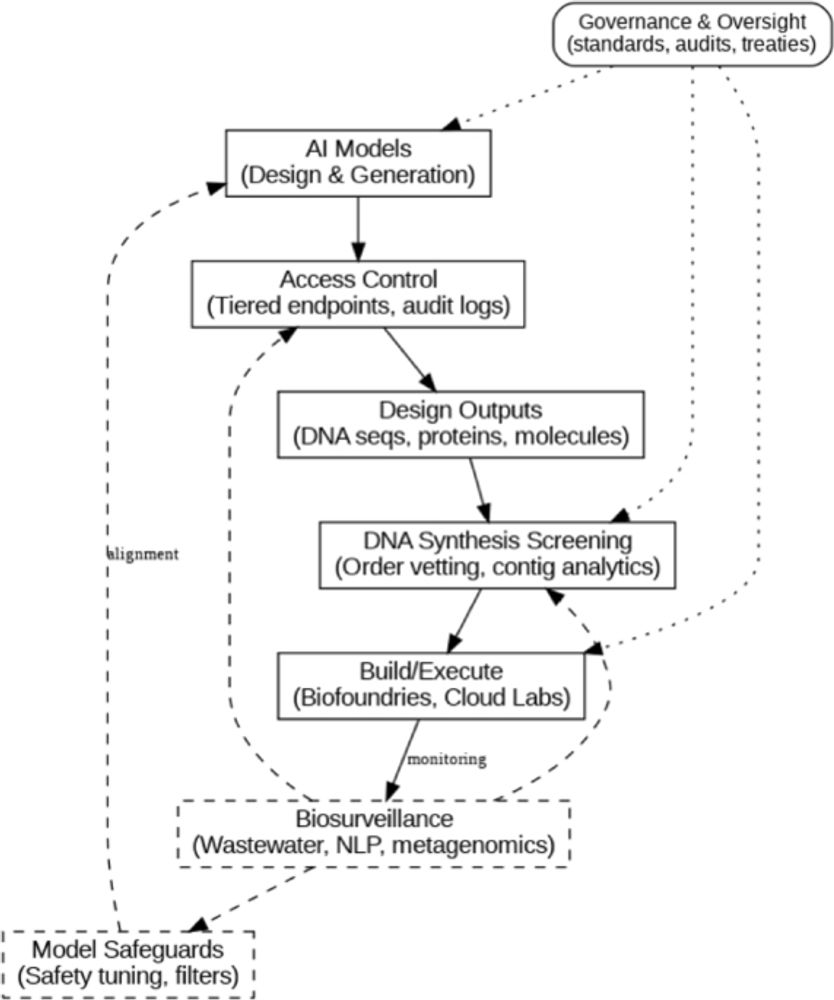
AI is accelerating what synthetic biology can do in fairly concrete ways: design throughput is increasing, expertise barriers dropping, and the timeline from concept to engineered organism getting shorter.
However, despite the genuine potential for therapeutics and biomanufacturing, the same acceleration also lowers the barrier to misuse. A review of 119 studies in AI and Ethics found that the governance landscape is fragmented in a specific way. Biosafety regimes were built around physical agents and laboratory controls, whereas AI governance frameworks focus primarily on the aspects of privacy and algorithmic fairness. The space where AI tools can design novel biological sequences sits in a rather unaddressed gap.
The issue is arguably structural rather than a matter of speed. Layered approaches (risk-tiered model access, DNA-synthesis screening, red-teaming, etc.) are gaining traction in the literature, but standardized implementation across the field still seems largely absent. And as AI-enabled biology scales, the window for building governance around it rather than after it seems likely to narrow accordingly.
link.springer.com/article/10.1...