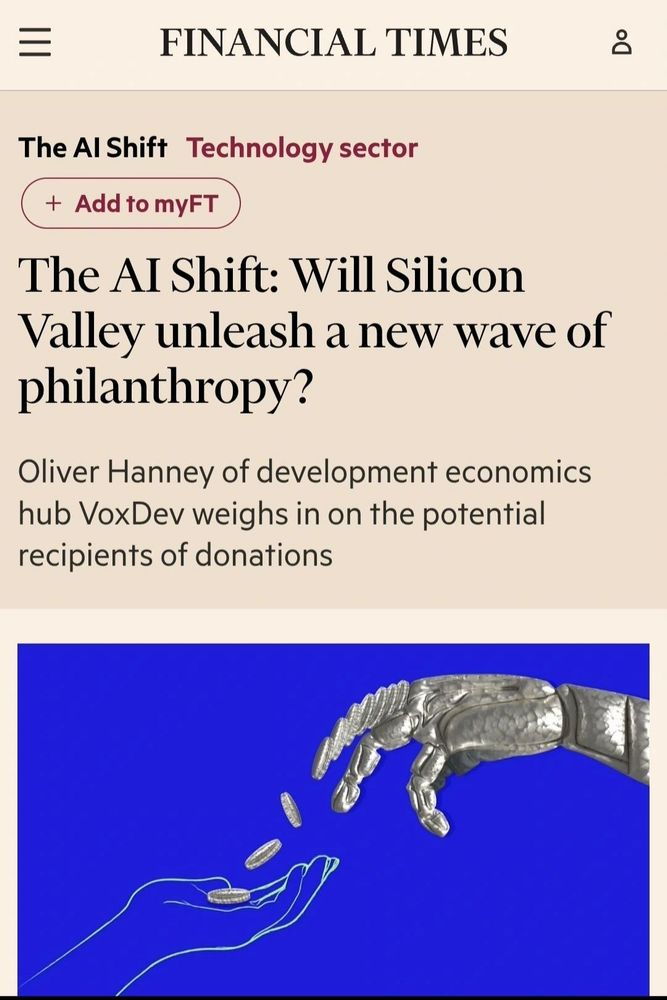
Just read this piece in Financial Times by Oliver Hanney of VoxDev. So in summary:
⚫The new wave of philanthropy will prioritize people who move fast and are really good at communicating their vision to others. So think VC style philanthropic funding.
⚫But he cautions that most problems in LMICs may not be solvable with a start-up mindset.
⚫He also adds that there will be a focus on global health and development, local institutions in LMICs, capacity building and systems strengthening.
⚫When asked about what development economists can do differently in the AI era, he said that development economists need to move fast in disseminating ideas and research: a typical research cycle can take up to five years.
I agree with all these. But to add...
🟠Development economists need to invest more time vetting and championing other methods for rigourous evidence besides the RCT.
🟠Don't get me wrong the RCT has been useful but we do need other methods.
Why?
🔴I'm very concerned that this current wave of philanthropic will put a disproportionate emphasis on quantitative causal evidence i.e. RCTs because of their affiliation to EA.
🔴If this happens, there is a real tendency to fall into the legibility trap, as described by Justin Steele, where elite grantmakers already in the space are favoured over people most closest to the problem.
🔴So basically, what we have is the third wave doing no different from the first two waves, by reinforcing Global North dominance in global philanthropy.