These coffee cups actually have a next step.
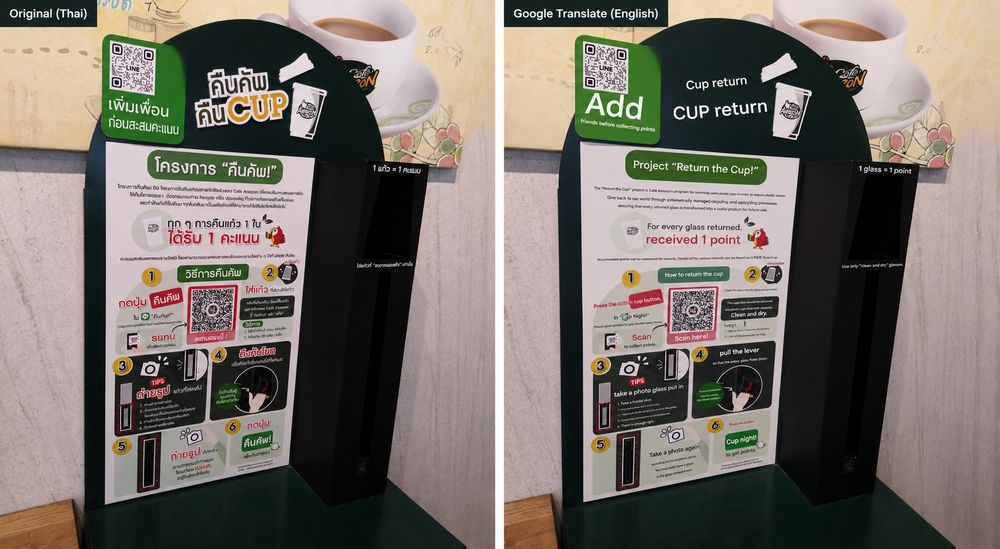
I spotted what I thought was a cup-return point inside a coffee shop in Thailand.
At first, I thought it was just another place to dump cups, but when I looked properly, it’s actually more thought-out than that and a pretty great example of recycling and circularity.
The goal is to get people to return their disposable cups in good condition, so that they can be upcycled. Yes, there's a small incentive (each cup is worth one loyalty point), so customers can get a small discount if they return enough cups.
It kind of makes disposal feel like part of the customer journey itself.
Buy drink → finish drink → return cup → get points.
It sounds obvious, but that missing “next step” is often where circular systems break down.
Just to be clear, Café Amazon does sell a wide range of permanent tumblers that are designed to be washed and reused. But this ‘Return the Cup!’ project seems like a great solution for customers who just want to get a disposable cup.
I think this type of system shows that people are usually willing to participate, but only if the action is easy, visible, and built naturally into their routine.
It made me wonder: how many waste problems are actually design problems?
@jonathandeller
Jonathan Deller
12Following
18Followers
I’m a teacher based in Thailand exploring how systems shape behaviour, from AI in education to circularity in everyday life. In the classroom, I focus on foundational human skills: attention, collaboration, emotional regulation, and cognitive development. Outside the classroom, I’m interested in how technologies and local initiatives, from AI tools to community recycling projects, influence how people think, act, and create change.
Posts
Pages
Recent posts
This machine doesn’t see plastic bottles as trash ♻️
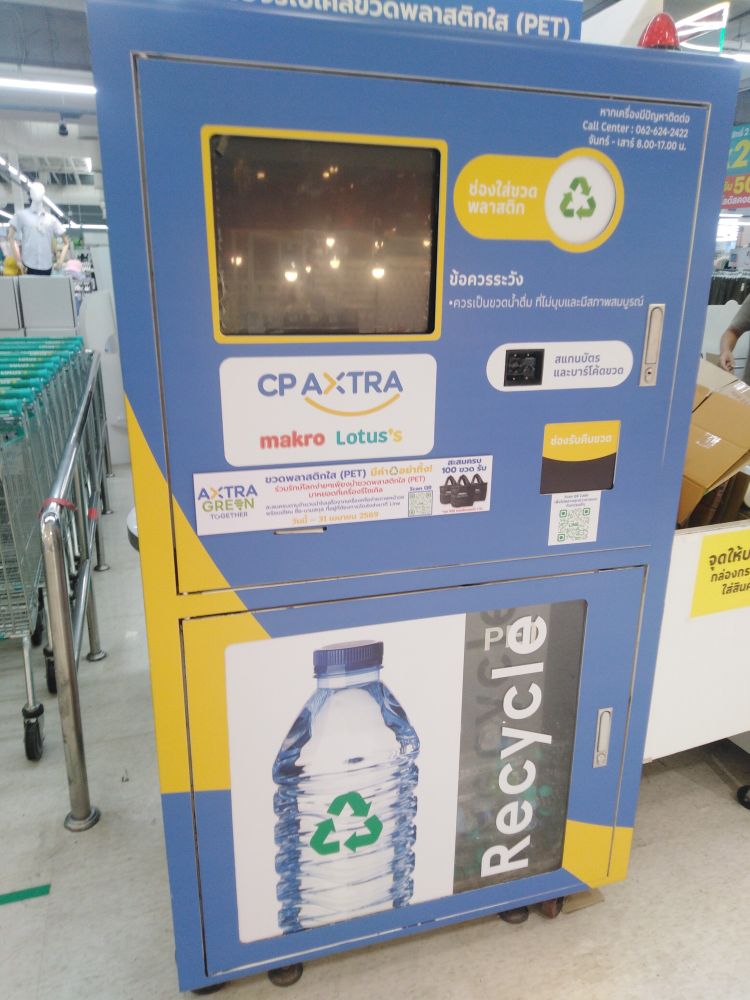
I spotted this bottle-return machine inside a supermarket in Thailand and was really struck by the message: “Clear plastic (PET) bottles are valuable, don’t throw them away!”
Rather than just being a normal recycling bin, there’s actually a small reward built in: if you collect 100 bottles, you get a free reusable bag, which is a nice little extra.
As you can see from the photo, the machine wasn’t working when I saw it (might need to be emptied!). Still, I quite liked the idea behind it. It made me realize that plastic isn’t always the whole problem; a lot depends on what systems are in place after we use it.
This machine gives people an obvious path for plastic bottles after using them, and actually makes the next step so obvious that people barely have to think.
I love seeing different companies designing better routes for materials after use. In this case, the company has a great idea for a machine, but just needs to look into maintaining the machine a little more regularly!
This made me wonder: how much is waste really just a logistics problem?
THIS ISN’T ACTUALLY A RECYCLING BIN 👟
I recently spotted this bin at a sports store in Thailand and initially assumed it was for shoe recycling. After all, the opening is shaped like a giant sneaker :)
But it’s actually way smarter than that.
The bin is part of a campaign called May Move Up, which encourages people to donate any gently used athletic shoes.
They simply put them in a special bag and write an inspirational message on the side. The shoes are then cleaned before being passed on to children in remote areas.
I really like simple ideas like this that help useful products stay in use for longer instead of being thrown away too soon.
In my last few posts, I’ve looked at bottle cap recycling, label-free water bottles, and battery collection bins, but this feels like the step before all of those.
I’d love to see more companies try ideas like this and make reuse feel this easy.
This made me wonder, how much waste could be avoided if we designed better systems for reuse first?
THIS RECYCLING BIN LOOKS LIKE A BATTERY 🔋
I spotted this fantastic example of circularity and recycling - a battery recycling point from Panasonic, set up as part of a joint project (with CP ALL, 7-Eleven, and other partners).
It’s designed specifically for AA, AAA, C and D batteries, but instead of a generic bin, it actually looks like one. Simple, but you instantly know what it’s for without thinking. And it’s right outside a 7-Eleven where the batteries are sold.
What’s also interesting is what it doesn’t accept. Unfortunately, you can’t just chuck power banks or button batteries in there! Panasonic seems keen to collect only the main type of consumer batteries, which is fair enough.
In my last posts, I looked at an organization that recycles bottle caps and a company that makes label-less bottles. This battery bin feels like another layer, designing the interaction to be as frictionless as possible.
The circularity of collecting used batteries right outside where they are sold means that people understand instinctively what to do.
This got me thinking: how much of circularity is actually solved at this level? Making the right action obvious, and the wrong one harder?
Can you see what’s missing from this water bottle?
I spotted this at a 7-Eleven in Thailand, and it took me a moment to realize it has no plastic label!
The brand name - Sprinkle - is moulded directly into the bottle, and the barcode is printed on the cap.
It looks like a small detail, but across millions of bottles, it probably means that a surprising amount of material never reaches a landfill site.
Sprinkle’s main business is filtered water delivery (think office water coolers), but even though single-use bottles get a bad rap, this idea is pretty smart, and I hope it catches on.
In my last post, I looked at recycling bottle caps. This feels like the step before that, designing some of the waste out before it even exists.
We often focus on what happens after something is thrown away. But maybe the bigger opportunity is earlier, at the design stage.
Are these small design decisions where real circularity actually begins?
Can you believe all of these things are made from recycled bottle caps?
At the school I work at in Thailand, we collect plastic bottle caps and give them to an organisation called Precious Plastic Bangkok.
They come to collect the caps and take them away to be shredded, melted, and remoulded into new products, like the ones you see in the photo below.
Caps that might have otherwise ended up in landfill, canals, or the ocean become something usable again. They are then sold (online and at markets) to raise money, which is used to help local communities with other recycling projects.
What I’ve noticed is that this changes behaviour: students stop seeing plastic as waste and start seeing it as something potentially valuable.
Circularity becomes real, not abstract.
Does real change start with systems… or with small, visible actions like this?
AI in education feels most useful when it’s invisible, or at least very well hidden!
I’ve been experimenting with Seesaw’s new AI “Generate Activity” feature. Instead of prompting it manually each time, I paste my full Scheme of Work into Gemini and ask it to generate structured prompts aligned to learning objectives.
The result? Much better activities, fewer iterations, and far more consistency across lessons.
In my experience, chaining different models into a single workflow is the way to go.
Curious how others in this space are approaching this. Are you relying on single tools, or building multi-step AI workflows for more consistent results?
A post on X by Brett Winton, Chief Futurist at ARKInvest, really caught my eye today. He shared a graph showing that AI-written text exceeded human-written text for the first time last year.
Since then, literally millions of autonomous agents have come online, especially following the release of OpenClaw. It's now come to the point where agents have their own social networks (such as moltbook) that humans can read, but only agents can post on.
It reminded me of the ongoing debate over whether, at some point, we'll have to settle on a universally agreed-upon way to distinguish between AI-generated text and human-written text.
We've already seen some attempts at this, such as the Sam Altman-backed World project with its controversial iris-scanning 'orbs'. The idea of the World app is that people can 'prove' they are human and not AI.
But most people don't like the idea of using an eye scanner, and several countries, including Germany, Colombia, and Thailand, have already restricted the project.
I'm curious what other people in this space think: will we all just accept that, in the future, the vast majority of text online will be AI-generated?
Or do you think we will agree on a safe, ethical way of identifying human-written content?
Brett's post is here, and it's worth a read: x.com/wintonARK/st...