@kriss avatar
@kriss

Kriss Taylor

Innovation StrategistUnited Kingdom

11Following 29Followers

I’m a researcher, product strategist and innovation specialist and founder of Responsible innovation Lab. ​ An engineer and anthropologist, I decode technological possibilities and untangle human motivations to align innovation with real-world needs of people and society. My work connects technology advancement to life-centered outcomes - ensuring innovation effort are done with clear intent and purpose. Specialised in helping multinational clients tackle innovation for cross-cultural challenges.​​

https://responsibleinnovationlab.co/links
Posts
Pages

Recent posts

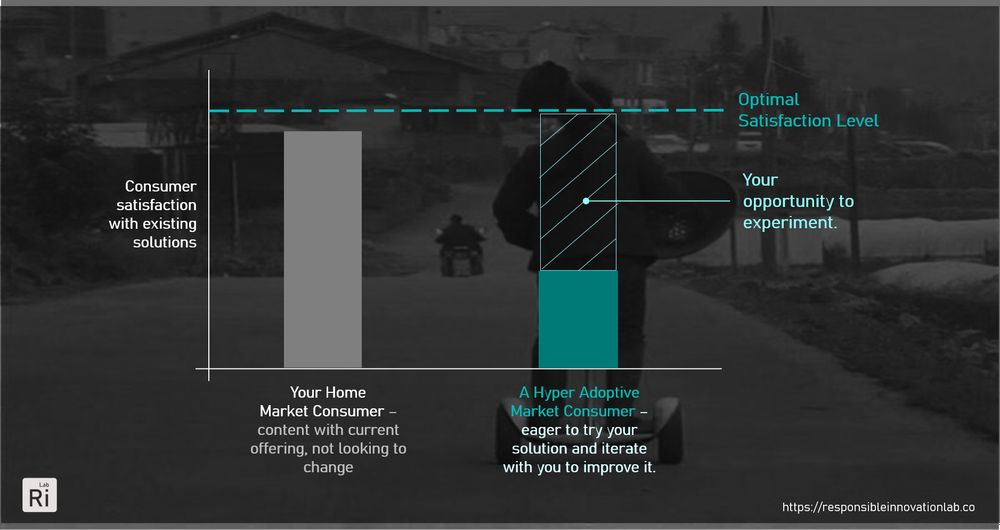
Innovation isn’t just about invention - it’s about how and where ideas take root. Our pursuit of innovation has often fixated on the potential for invention, we often think of innovation as the moment a new idea is born - usually in a lab, a studio or a startup, but in reality, this is only half the journey. The second half of that journey requires the invention to be adopted by people and without that adoption, an invention remains just an idea… So when we seek to understand adoption, it’s important to recognise that the 'early adopters' may not be in the country where the invention occurred. In today's highly connected world, the early adopters of an invention could exist anywhere. In fact, the countries undergoing rapid economic and social change are often where we find the people who are the most open and adaptive to new ideas. Take Kenya, for example. In a country experiencing rapid economic and social shifts, we’ve seen how innovations that originated elsewhere can find unexpected success. In Nairobi, mobile payments like M-Pesa in a matter of months became an integral part of daily life, changing the way people interact with money. What’s striking is how quickly these new tools are adopted and then adapted to better suit local needs. This highlights a key point: the place where an idea originates is not always the best place to test its potential. In fact, it’s often in environments undergoing significant change - where new ideas are most likely to be embraced and transformed. To understand how an innovation can truly make an impact, we need to look to places that are ready to experiment, adapt and push the boundaries of what’s possible. It’s in these spaces where the real innovation happens. Learn more about Responsible innovation Lab’s approach to innovation with our free ebook: www.responsibleinnovationlab.co/publications...
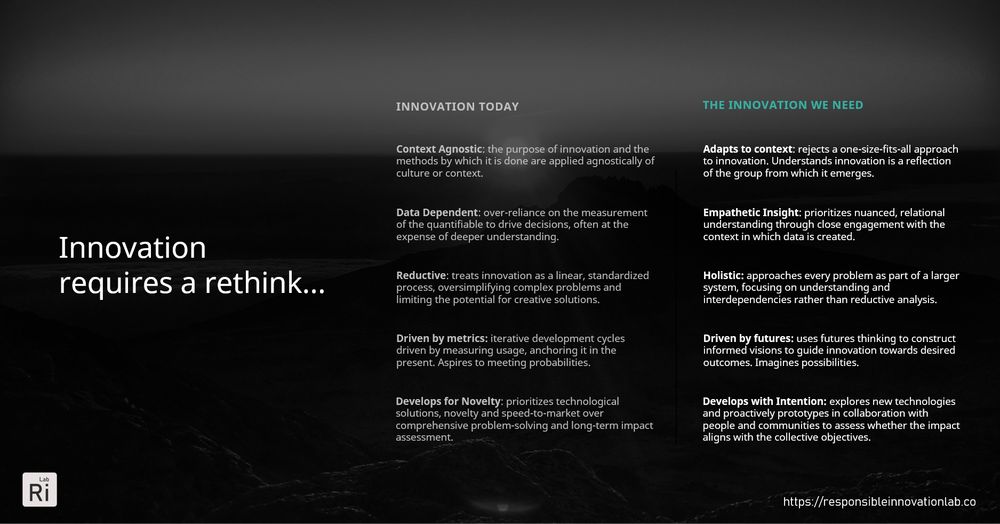
Let’s be honest: the way we innovate is a little broken. Innovation was once a practice designed to bring people together - to ritualise and orchestrate our collective creativity toward solving the challenges of the time. But somewhere along the way, something changed. Today, innovation is often driven by action over thinking, speed over quality and profit over real value. What was once a practice for overcoming our uncertainty, has too often become the source of that uncertainty. We find ourselves moving at breakneck speed, churning out products, technologies, and business models, endlessly optimized, but rarely questioned. In this rush, we’re neglecting the slow, systemic and complex issues that can’t be solved with quick fixes. These challenges are not unimportant; they’re inconvenient. They don’t fit the fast pace of today’s market. They don’t deliver immediate returns. As innovators, we’re meant to inspire, yet we too often we find ourselves chasing probabilities instead of creating possibilities. Trapped in a culture of measurement, we’ve lost our appetite for risk. Our intuition feels distant and our imaginations have atrophied. Somewhere along the way, we’ve forgotten what it truly means to be innovators. But what if we could change that?

Connect with Kriss Taylor

Join Inspired