Nova + Nuron from Genesis Energy Systems is an adaptive energy platform designed to generate, store, and intelligently distribute power directly within the built environment.
It operates as a live, spatial energy layer, capturing ambient and kinetic input, converting it in real time, and routing energy dynamically across a connected mesh. Each unit contributes to a wider system that learns from movement, usage patterns, and environmental signals, continuously optimising how energy is generated and where it flows.
Deployment is fast and non-intrusive, integrating seamlessly into spaces such as transport hubs, commercial environments, and public infrastructure—without disruption or dependency on central systems.
The result is simple: energy produced where people are, delivered where it’s needed, and managed by a system that adapts in real time.
Recent posts
Modern infrastructure was designed to consume energy, not participate within the environments it serves.
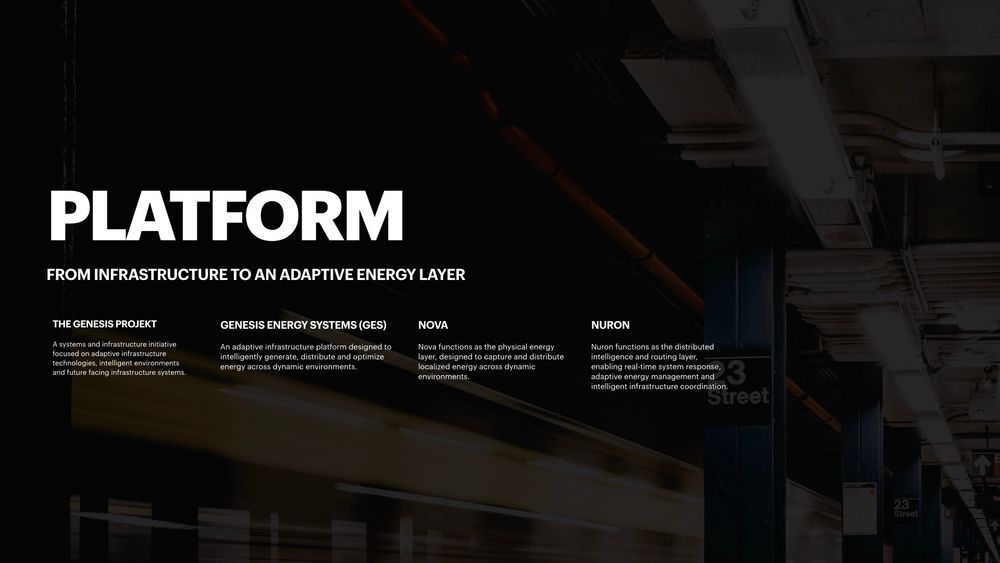
GES (Genesis Energy Systems) is an adaptive infrastructure platform developed under The Genesis Projekt, designed to intelligently generate, distribute and optimize localized energy across dynamic environments.
Powered by the Nova energy layer and Nuron intelligence platform, GES explores a future where infrastructure becomes responsive, distributed and adaptive rather than static and passive.
Designed initially for transport infrastructure, airports, retail, hospitality and high-footfall public environments.
Swipe to explore the platform.
Investment
Collaboration
Partnership
That is why the idea of a purely technological solution increasingly feels incomplete. Technology can optimise systems. It can improve efficiency. It can reduce operational emissions. But it cannot, on its own, resolve a model built around infinite expansion across finite planetary systems.
At some point, the conversation has to move beyond energy alone and confront the industrial behaviours sitting underneath it:
disposability, planned obsolescence, mass extraction, perpetual consumption, and economic structures that depend on continuous growth regardless of ecological consequence.
Because climate change was never created by electricity in isolation.
It emerged from the cumulative behaviour of an industrial civilisation operating without meaningful long-term equilibrium between growth, extraction, and planetary limits.
And unless that underlying behaviour changes, there is a risk that the transition itself simply becomes another phase of industrial expansion rather than a genuine departure from it.
Cleaner perhaps.
More efficient perhaps.
But still moving in fundamentally the same direction.
Investment
Collaboration
Partnership
The problem with treating climate change purely as an energy issue is that it narrows the scope of the conversation to technology, while leaving the underlying behaviour of industrial civilisation largely unquestioned.
The assumption is that if energy becomes cleaner, the system itself becomes sustainable.
But those are not necessarily the same thing.
A civilisation can electrify transport, decarbonise sections of its grid, expand renewable infrastructure, and still remain fundamentally dependent on continuous extraction, continuous expansion, and continuously rising material consumption in order to sustain economic growth.
And that is where the discussion becomes far more uncomfortable than simply debating fossil fuels versus renewables.
Because the deeper issue may not be how civilisation is powered, but how civilisation operates.
Modern economies are still overwhelmingly structured around perpetual growth. More production, more consumption, more infrastructure, more manufacturing, more resource throughput. Technological efficiency may slow the rate of damage in certain areas, but efficiency alone does not necessarily alter the underlying logic driving the system forward.
In many cases, it simply allows the system to scale more effectively.
Investment
Collaboration
Partnership
The transition is often presented as though it represents a departure from extractive industrial systems, while simultaneously depending on a significant expansion of extraction itself in order to function. The technologies may operate more cleanly once deployed, but the industrial foundation beneath them remains heavily resource intensive.
That distinction matters because operational cleanliness is not the same as systemic sustainability.
Reducing emissions in one layer of the system does not automatically resolve the wider material pressures being created elsewhere. If a transition depends on continuous large-scale extraction, continuous infrastructure replacement, and unresolved end-of-life recovery systems simply to sustain itself, then the question is no longer whether it is cleaner than what came before. The question becomes whether the underlying industrial logic has changed at all.
And so far, much of that logic appears remarkably familiar.
Extract.
Manufacture.
Deploy.
Replace.
The technologies evolve, but the behavioural structure underneath remains largely intact.
Which raises an uncomfortable possibility: that future generations may inherit not the end of industrial dependency, but a more technologically advanced version of the same dependency, requiring continuous extraction and increasingly complex recovery systems simply to maintain the infrastructure designed to solve the previous crisis.
Investment
Collaboration
Partnership
One of the more overlooked aspects of the energy transition is how little discussion exists around what happens after deployment. The public conversation is overwhelmingly centred around rollout and adoption: more electric vehicles, more battery storage, more solar, more wind. Progress is largely measured through installation targets and expansion curves, as though scaling infrastructure automatically represents resolution.
But infrastructure is not static. It ages, degrades, requires maintenance, and eventually reaches the end of its operational life. Solar panels gradually lose efficiency over time. Battery systems lose capacity through repeated charge cycles. Wind turbines require constant servicing, component replacement, lubrication systems, and eventually full structural retirement. And unlike traditional consumer products, much of this infrastructure exists at enormous physical scale, making recovery and replacement significantly more complex.
This is where the conversation begins to shift from deployment to sustainability itself.
Building infrastructure is one challenge. Maintaining it across decades of continuous operation is another entirely. Recovering, recycling, dismantling, and replacing that infrastructure at global scale introduces a second layer of industrial demand that remains comparatively absent from mainstream discussion.
At the same time, the transition is accelerating pressure on entirely new extraction chains. The demand for lithium, copper, nickel, cobalt, graphite, and rare earth materials continues to rise as countries attempt to electrify transport, expand battery production, modernise grids, and scale renewable infrastructure simultaneously. Mining operations are expanding rapidly to meet this demand, alongside the heavy industrial systems required to process, transport, manufacture, and deploy these materials globally.
And this is where a deeper contradiction begins to emerge.
Investment
Collaboration
Partnership
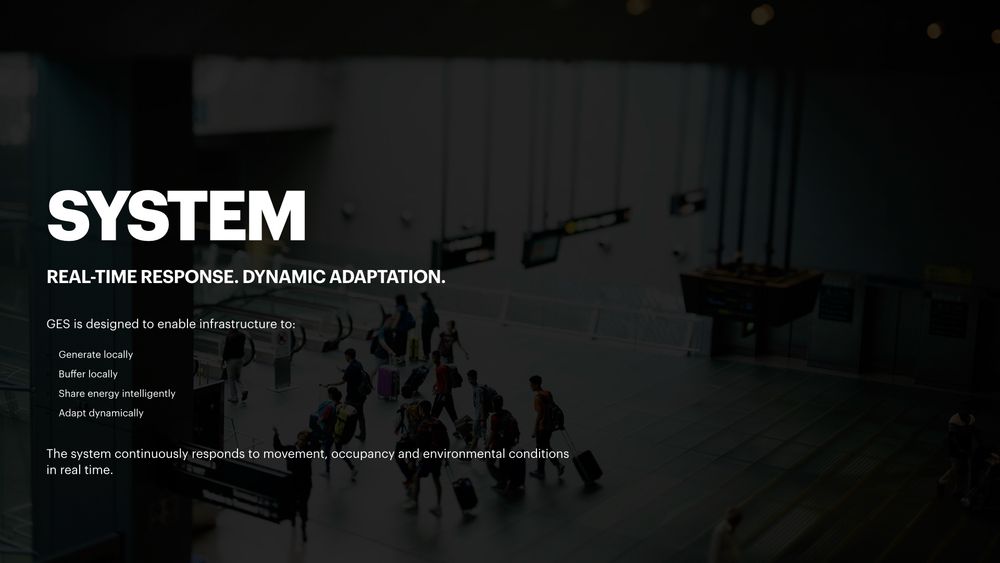
When energy moves closer to the environments that use it, the system stops operating blindly.
In a centralised model, energy is produced at scale and pushed outward. It doesn’t see the conditions it’s feeding into. It doesn’t recognise when demand is building in one place and easing in another. It simply delivers an amount based on forecasts, averages, and the need to stay ahead of potential peaks.
It works, but it works without awareness, so everything around it has to compensate. Infrastructure absorbs the spikes. Storage smooths variation. Excess capacity is held in reserve to cover moments the system can’t predict precisely. The more dynamic the environment, the more the system has to overcorrect to maintain stability.
That is what it means to operate without visibility of the conditions you are serving, but when energy exists within those environments, that changes. It becomes part of the same conditions that create demand in the first place. It can respond to where activity is forming, how it is shifting, and how pressure builds and releases across a space. But awareness on its own isn’t the advantage.
Adaptation is.
Because once a system can see what’s happening, it can begin to adjust to it. Not just in the moment, but over time. It can learn how demand forms, where it concentrates, how it moves, and how different conditions affect it. And as it learns, it improves. Energy isn’t just delivered more precisely, it is positioned more effectively, routed more intelligently, and used more efficiently with each cycle.
Now the system is no longer reacting in isolation, it is refining its behaviour continuously, reducing the need for overcompensation, and improving how energy is distributed across the environment over time.
That doesn’t remove complexity, but it changes how that complexity is handled, from trying to predict everything in advance, to understanding and responding to conditions as they unfold.
And that is a fundamentally different way of operating.
Investment
Collaboration
Partnership
Centralised energy was built around a simple idea: produce power in large quantities, then move it to where it is needed.
For a long time, that made sense. Large power stations created consistency. Transmission networks carried energy across distance. The system was designed to serve many different places from a smaller number of controlled sources.
Its strength was scale. But scale also creates distance.
The further energy moves from where it is produced to where it is used, the more the system has to manage in between. It has to forecast demand, absorb peaks, balance supply, build redundancy, and maintain enough capacity for moments that may only happen briefly.
That is the trade-off of centralisation. It gives us reach, but it also forces the system to treat very different environments as part of the same broad demand problem.
A station, an airport, a hospital, a school, a residential street, and a shopping district do not use energy in the same way. They have different peaks, different patterns, different pressures, and different margins for failure. But under a centralised model, much of that difference is flattened into averages, forecasts, and capacity planning.
That is where decentralisation starts to matter. Not as a rejection of central energy systems, but as a way of bringing energy closer to the environments that use it.
Investment
Collaboration
Partnership
For centuries, we’ve built energy systems around what we can extract, measure, and control; mapping oil, wind, and solar with precision, and learning how to scale them across regions. What we haven’t really learned to see is something much closer.
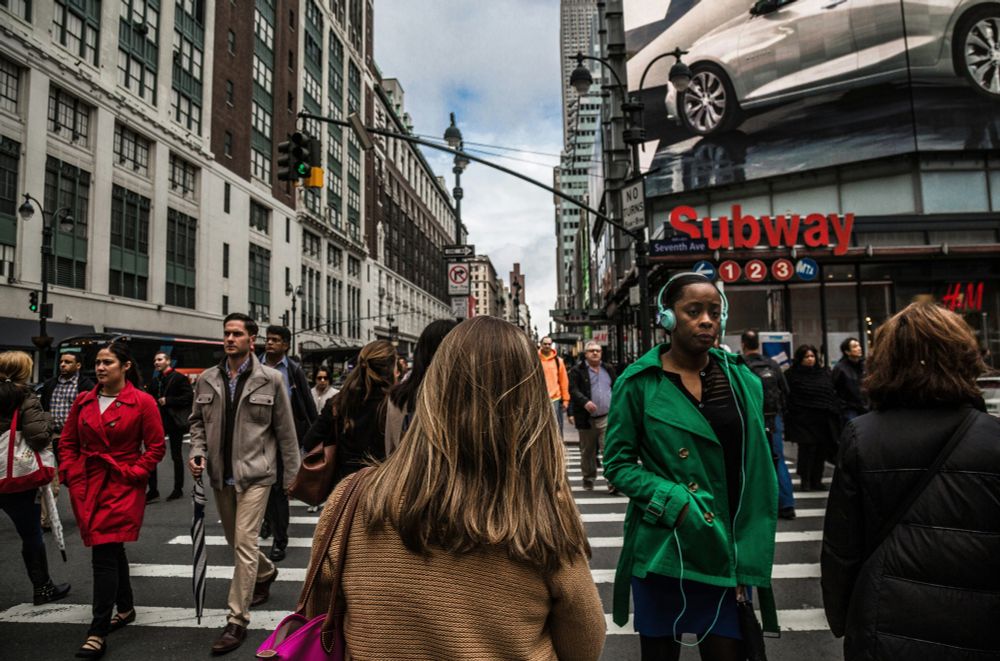
Every day, we move through the world in patterns. We follow the same routes, gather in the same places, and return again. It feels ordinary because it’s routine, but that routine is one of the most consistent systems we have.
All of that movement; every step, every interaction with the spaces around us is energy in motion, and yet, it sits outside of the way we think about energy.
The legacy systems we’ve built assume energy is generated elsewhere and delivered to us. But demand today is dynamic and requires a different system approach. A modern system must respond to where people are, how they move, and how spaces are used throughout the day.
Once you begin to look at it properly, the patterns are clear. Human movement can be mapped and utilised. What we’re seeing isn’t chaotic movement, it’s a level of orchestration we haven’t yet recognised - the energy already present within the environments we occupy.
In a human activity–centred system, energy becomes local, distributed, and adaptive; captured where activity already exists and moved as demand changes. As those points connect, an intelligent layer forms across environments, shaped by how people move rather than how infrastructure has been designed.
At that point, energy stops being something delivered into a space. It becomes part of the space itself. And once you see it that way, the question isn’t whether it’s possible. It’s why we’ve spent so long building around everything except the one constant that was there from the beginning.
Investment
Collaboration
Partnership